Across a metallic conductor of non-uniform cross section a constant potential difference is applied. The quantity which remains constant along the conductor is
AIPMT 2015, Easy
Download our app for free and get started
The area of cross section of conductor is non uniform so current density will be different but the flow of electrons will be uniform so current will be constant.

Download our appand get started for free
Experience the future of education. Simply download our apps or reach out to us for more information. Let's shape the future of learning together!No signup needed.*
Similar Questions
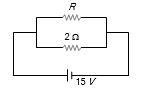
- 1If in the circuit, power dissipation is $150\, W$, then $R$ is ............... $\Omega$View Solution
- 2In $n_e$ and $v_d$ be the number of electrons and drift velocity in a semiconductor. When the temperature is increasedView Solution
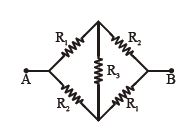
- 3The equivalent resistance between ends $A$ and $B$ isView Solution
- 4A potentiometer wire has length $10\, m$ and resistance $20\,\Omega $. A $2. 5\, V$ battery of negligible internal resistance is connected across the wire with an $80\,\Omega $ series resistance. The potential gradient on the wire will beView Solution
- 5A heating coil is labelled $100\, W$, $220\, V$. The coil is cut in half and the two pieces are joined in parallel to the same source. The energy now liberated per second is .............. $J$View Solution
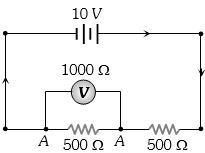
- 6What is the reading of voltmeter in the following figure .............. $V$View Solution
- 7The power rating of an electric motor which draws a current of $3.75\, amperes$ when operated at $200\, V$ is aboutView Solution
- 8The resistance of the series combination of two resistance is $S$. When they are joined in parallel the total resistance is $P$. If $S = nP$, then the minimum possible value of $n$ isView Solution
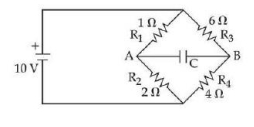
- 9The charge accumulated on the capacitor connected in the following circuit is________ $\mu \mathrm{C}$ (Given $\mathrm{C}=150\ \mu \mathrm{F}$ )View Solution
- 10A potential difference of $10 \,V$ is applied across a conductor of $1000 \,\Omega$. The number of electrons flowing through the conductor in $300 \,s$ is ..........View Solution