A potential difference of $10 \,V$ is applied across a conductor of $1000 \,\Omega$. The number of electrons flowing through the conductor in $300 \,s$ is ..........
Easy


Download our appand get started for free
Experience the future of education. Simply download our apps or reach out to us for more information. Let's shape the future of learning together!No signup needed.*
Similar Questions
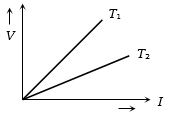
- 1The voltage $V$ and current $I$ graph for a conductor at two different temperatures ${T_1}$ and ${T_2}$ are shown in the figure. The relation between ${T_1}$ and ${T_2}$ isView Solution
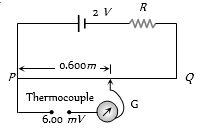
- 2Figure shows a simple potentiometer circuit for measuring a small $e.m.f$. produced by a thermocouple. The meter wire $PQ$ has a resistance $5 \,\Omega$ and the driver cell has an e.m.f. of $2\, V$. If a balance point is obtained $0.600\, m$ along $PQ$ when measuring an e.m.f. of $6.00\, mV$, what is the value of resistance $R$ ............... $\Omega$View Solution
- 3You are given several identical resistances each of value $R = 10\,\Omega $ and each capable of carrying maximum current of $1\, ampere$. It is required to make a suitable combination of these resistances to produce a resistance of $5\,\Omega $ which can carry a current of $4\, amperes$. The minimum number of resistances of the type $R$ that will be required for this jobView Solution
- 4View SolutionSpecific resistance of a conductor increases with
- 5View SolutionThe temperature at which thermal electric power of a thermo couple becomes zero is called
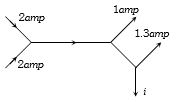
- 6The figure below shows currents in a part of electric circuit. The current $i$ is ............. $amp$View Solution
- 7The resistance of a wire is $20\, ohms$. It is so stretched that the length becomes three times, then the new resistance of the wire will be ............. $ohms$View Solution
- 8The terminal potential difference of a cell is greater than its $e.m.f.$ when it isView Solution
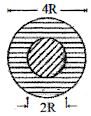
- 9A wire of circular cross section has inner portion of radius $R$ made of material of resisitivity $\rho$ and is surrounded by an outer portion of thickness $R$ made of a material of double resisitivity. Find the resistance of length $l$ of such wireView Solution
- 10If an electric heater is rated at $1000\, W$, then the time required to heat one litre of water from $20\,^oC$ to $60\,^oC$ isView Solution