Question
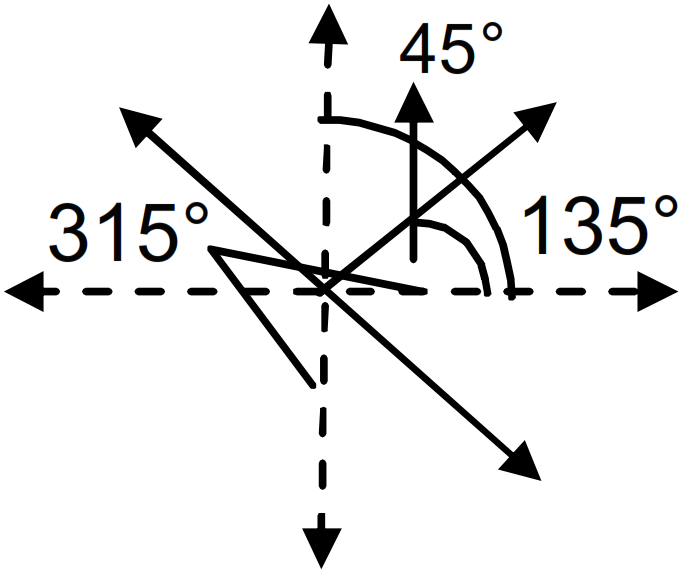
Add vectors $\overrightarrow{\text{A}},\overrightarrow{\text{B}}$ and $\overrightarrow{\text{C}}$ each having magnitude of 100 unit and inclined to the X-axis at angles 45°, 135° and 315° respectively.
Answer

x component of $\overrightarrow{\text{A}}=100\cos45^{\circ}=\frac{100}{\sqrt{2}}\text{ unit}$ x component of $\overrightarrow{\text{B}}=100\cos135^{\circ}=\frac{100}{\sqrt{2}}$ x component of $\overrightarrow{\text{C}}=100\cos315^{\circ}=\frac{100}{\sqrt{2}}$ Resultant x component $=\frac{100}{\sqrt{2}}-\frac{100}{\sqrt{2}}+\frac{100}{\sqrt{2}}=\frac{100}{\sqrt{2}}$ y component of $\overrightarrow{\text{A}}=100\sin45^{\circ}=\frac{100}{\sqrt{2}}\text{unit}$ y component of $\overrightarrow{\text{B}}=100\sin135^{\circ}=\frac{100}{\sqrt{2}}$ y component of $\overrightarrow{\text{C}}=100\sin315^{\circ}=\frac{100}{\sqrt{2}}$ Resultant y component $=\frac{100}{\sqrt{2}}+\frac{100}{\sqrt{2}}-\frac{100}{\sqrt{2}}=\frac{100}{\sqrt{2}}$ Resultant $=100$$\tan\alpha=\frac{\text{y component}}{\text{x component}}=1$
$\Rightarrow\alpha=\tan^{-1}(1)=45^{\circ}$
The resultant is 100 unit at 45° with x-axis.

Need a full question paper?

Generate a complete, print-ready paper with questions like this in minutes — across 16+ boards, with answer keys.
Start Generating Free

Similar questions

Derive the electric field generated due to the dipole at any point located on the equatorial plane of the electric dipole. Draw the necessary diagram.
Figure shows a square loop ABCD with edgelength a. The resistance of the wire ABC is r and that of ADC is 2r. Find the magnetic field B at the centre of the loop assuming uniform wires.
Consider the potentiometer circuit as arranged in the figure. The potentiometer wire is 600cm long. (a) At what distance from the point A should the jockey touch the wire to get zero deflection in the galvanometer? (b) If the jockey touches the wire at a distance of 560cm from A, what will be the current in the galvanometer?
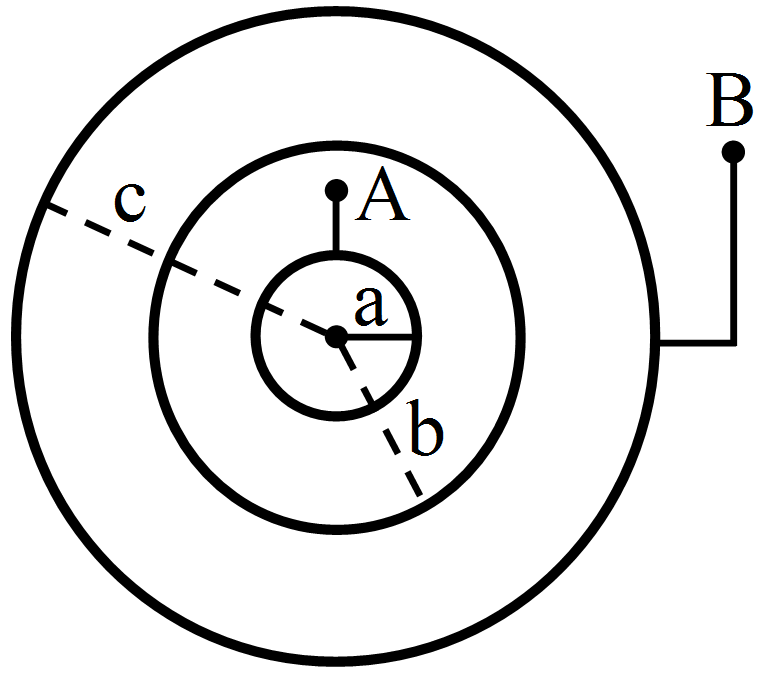
Consider an assembly of three conducting concentric spherical shells of radii a, b and c as shown in figure. Find the capecitance of the assembly between the poima A and B
Two wires carrying equal currents i each, are placed perpendicular to each other, just avoiding a contact. If one wire is held fixed and the other is free to move under magnetic forces, what kind of motion will result?
Show that the magnetic field B at a point in between the plates of a parallel-plate capacitor during charging is $\frac{\in_0{\mu}_\text{r}}{2}\frac{\text{dE}}{\text{dt}}$ (symbols having usual meaning).
A car goes on a horizontal circular road of radius R, the speed increasing at a constant rate $\frac{\text{d}\nu}{\text{dt}}=\text{a}.$ The friction dt coefficient between the road and the tyre is $\mu.$ Find the speed at which the car will skid.
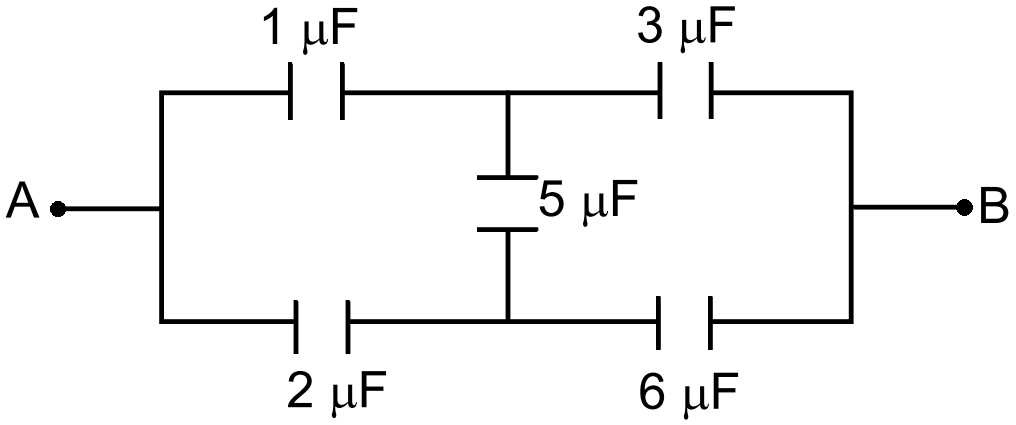
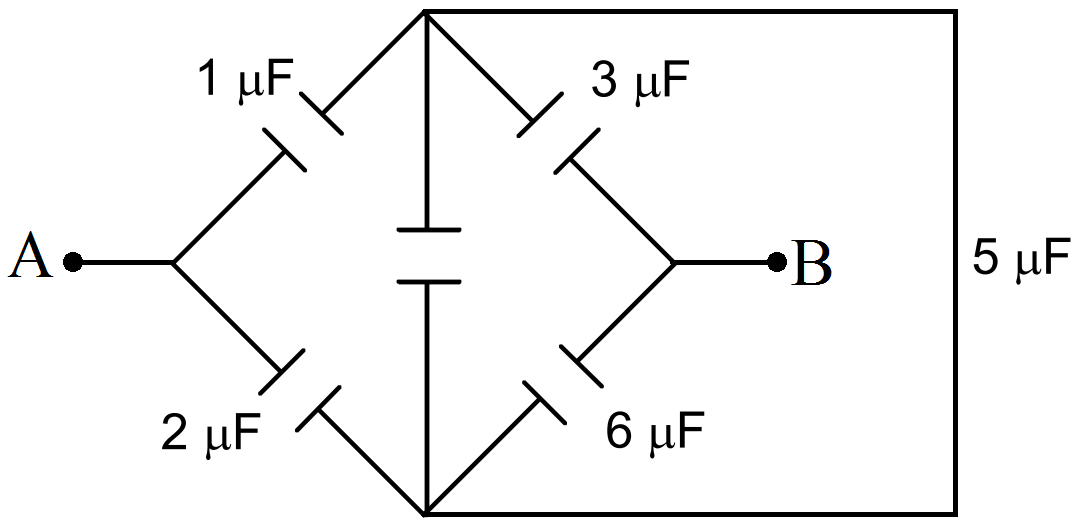
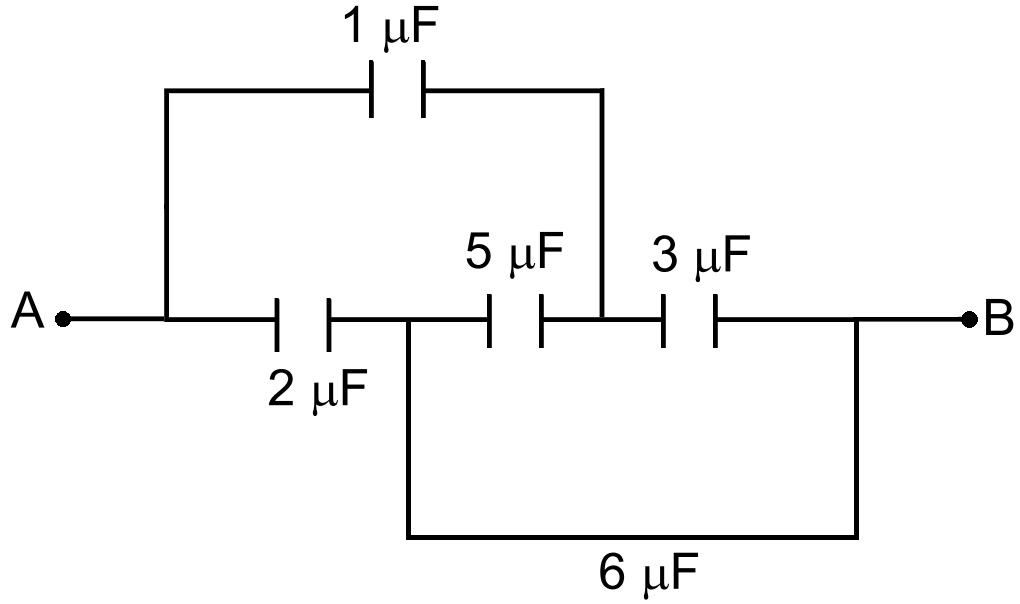
Convince yourself that parts (a), (b) and (c) of figure are identical. Find the capacitance between the points A and B of the assembly.


A mica strip and a polysterene strip are fitted on the two slits of a double slit apparatus. The thickness of the strips is 0.50mm and the separation between the slits is 0.12cm. The refractive index of mica and polysterene are 1.58 and 1.55 respectively for the light of wavelength 590nm which is used in the experiment. The interference is observed on a screen a distance one meter away.
  1. What would be the fringe-width?
  2. At what distance from the centre will the first maximum be located?
A particle on a stretched string supporting a travelling wave, takes 5.0ms to move from its mean position to the extreme position. The distance between two consecutive particles, which are at their mean positions, is 2.0cm. Find the frequency, the wavelength and the wave speed.