Question
Add:
  1. 8 + 6
  2. 9 + (-3)
  3. 5 + (-6)
  4. – 7 + 2
  5. – 8 + 0
  6. – 5 + (-2)

Answer

1. 8 + 6 = (+8) + (+6) = +142. 9 + (-3) = (+9) + (- 3) = +63. 5 + (-6) = (+5) + (-6) = -1
4. -7 + 2 = (-7) + (+2) = -55. -8 + 0 = (-8) + 0 = -86. -5 + (-2) = (-5) + (-2) = -7

Need a full question paper?

Generate a complete, print-ready paper with questions like this in minutes — across 16+ boards, with answer keys.
Start Generating Free

Similar questions

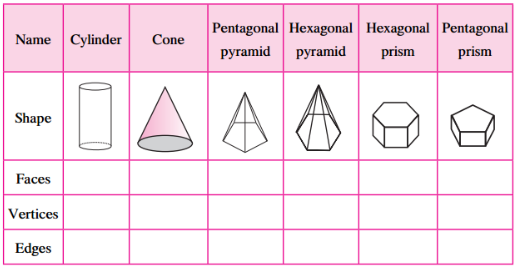
Write the number of faces, edges and vertices of each shape in the table.

Image

If AB = 7.5cm and CD = 2.5cm, construct a segment whose length is equal to:
2AB + 3CD
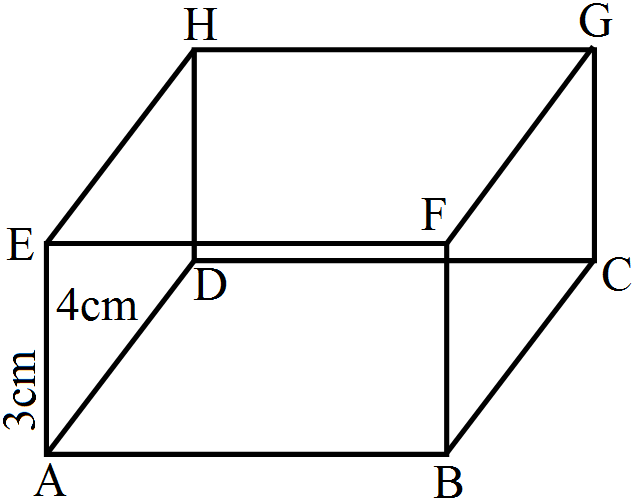
The dimensions of a cuboid with vertices A, B, C, D, E, F, G and H are as shown:


i. Which edges are of length 4 cm ? Which edges are of length 5 cm ?
ii. Which faces have area equal to $20 cm^2$ ?
iii. Which faces have the largest area? What is this largest area?
iv. Which faces have a diagonal equal to 5 cm ?
v . What is the area of the base of this cuboid?
vi. Do all the lateral faces have the same area?
Total number of students of a school in different years is shown in the following table:
Year
Number of students
1996
400
1998
550
2000
450
2002
600
2006
650
Represent the above data by a pictograph.
Prepare another pictograph of students using any other symbol each represents students. Which pictograph do you find more informative?
Draw the perpendicular bisector of a given line segment AB of length 6cm.
Avinash works as a lecturer and earns Rs. 12000 per month. His wife who is a doctor earns Rs. 15000 per month. Find the following ratios:
  1. Avinash's income to their total income.
  2. Avinash's income to their total income.
Construct $\angle\text{AOB}=85^\circ$ with the help of a protractor. Draw a ray OX bisecting $\angle\text{AOB}.$
Find the HCF of the numbers in the following using the division method:754, 1508, 1972
Draw a quadrilateral. Draw one diagonal of this quadrilateral and divided it into two triangles. Measures all the angles in the figure. Is the sum of the measures of the four angles of the quadrilateral equal to the sum of the measures of the six angles of the two triangles? Verity that this is so with other quadrilaterals.
Using a pair of compasses construct the following angles:
120°