Question
Using a pair of compasses construct the following angles:
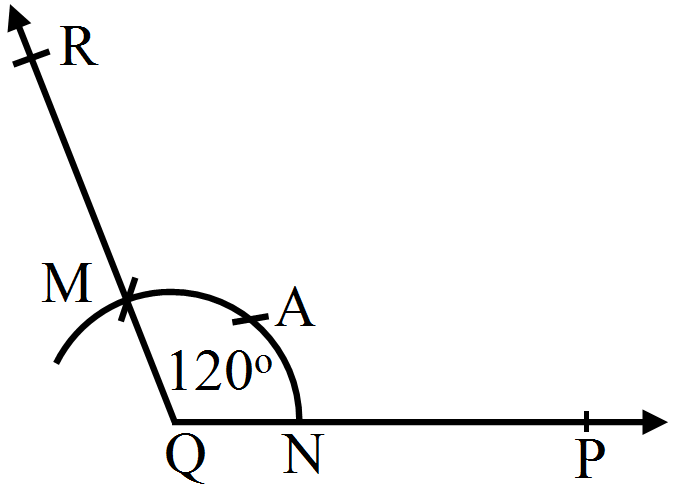
120°

Answer


Steps for construction:
  1. Draw a ray QP.
  2. With Q as the centre and any convenient radius, draw an arc cutting QP at N.
  3. With N as the centre and the same radius, cut the arc at A. Again, with A as the centre and the same radius, cut the arc at M.
  4. Draw QM and produce it to R.
$\angle\text{PQR}$ is the required angle of 120°.

Need a full question paper?

Generate a complete, print-ready paper with questions like this in minutes — across 16+ boards, with answer keys.

Start Generating Free

Similar questions

Ramanujan’s Magic square.

22121887
8817925
10248916
19862311
  • Add the four numbers in the rows, the columns and along the diagonals of this square.
  • What is the sum?
  • Is it the same every time?
  • What is the peculiarity?
  • Look at the numbers in the first row, 22 – 12 – 1887. Find out why this date is special.

Obtain and read a biography of the great Indian mathematician Srinivasa Ramanujan.

Draw a line segment of length 10cm and bisect it. Further bisect one of the equal parts and measure its length.
Draw a line segment AB of length 8cm. At each end of this line segment, draw a line perpendicular to AB. Are these two lines parallel?
The number of students of Std 6th and Std 7th who went to visit the Tadoba Tiger Project at Chandrapur was 140 and 196 respectively. The students of each class are to be divided into groups of the same number of students. Each group can have a paid guide. What is the maximum number of students that can be there in each group? Why do you think each group should have the maximum possible number of students?
Using a protractor, draw $\angle\text{BAC}$ of measure 45°. Take a point P in the interior of $\angle\text{BAC}.$ From P draw line segments PM and PN such that $\text{PM}\perp\text{AB}$ and $\text{PN}\perp\text{AC},$ Measure $\angle\text{MPN}.$
Round off each of the following numbers to nearest tens, hundreds and thousands:
  1. 964
  2. 1049
  3. 45,634
  4. 79,085
How to do this subtraction:$4 \frac{1}{4}-2 \frac{1}{2} ?$Is it same as$\left[4-2+\frac{1}{4}-\frac{1}{2}\right] ?$
Draw a line AB. Take a point P on it. Draw a line passing through P and perpendicular to AB.
Ravish's house is $\frac{9}{10}\text{km}$ from his school. He walked some distance and then took a bus for $\frac{1}{2}\text{km}$ up to the school. How far did he walk?
Use a pair of compasses and construct the following angles:
105°