Question
Addition of HBr to propene yields 2-bromopropane, while in the presence of benzoyl peroxide, the same reaction yields 1-bromopropane. Explain and give mechanism.
Answer

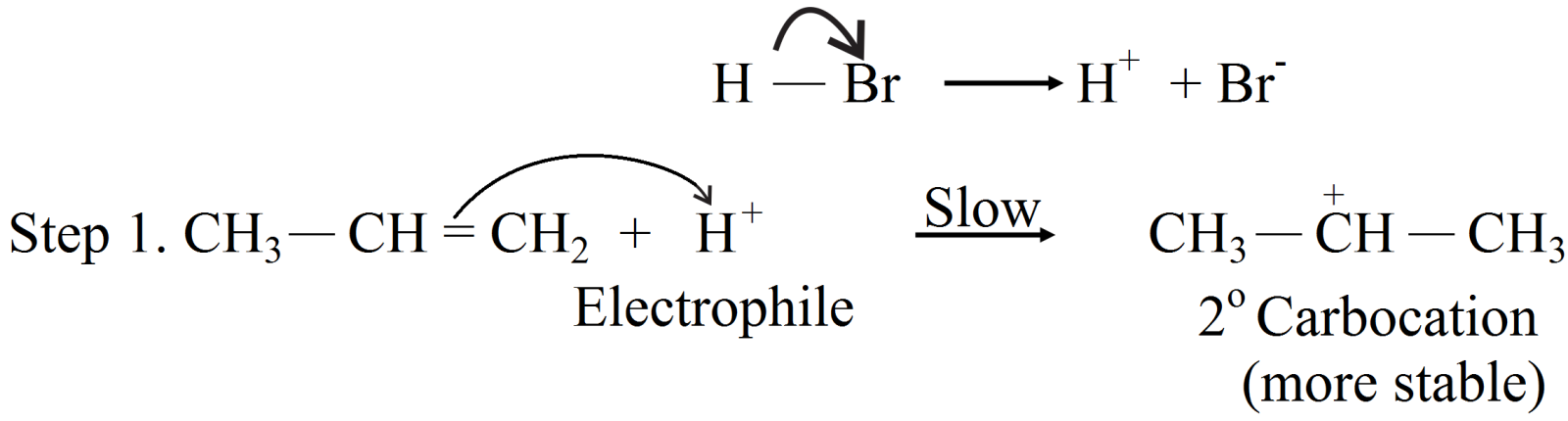
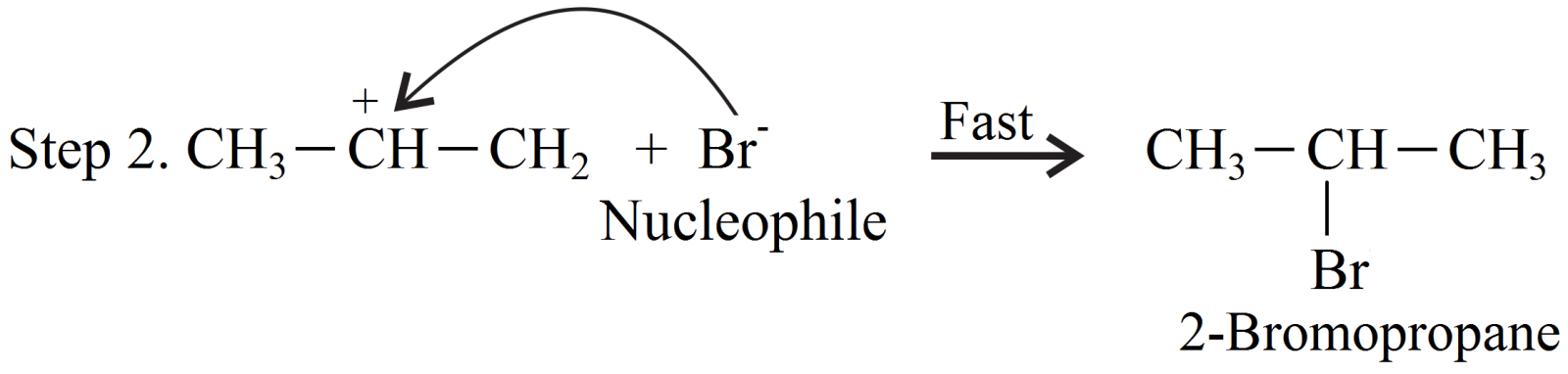
Addition of HBr to propene is an ionic electrophilic addition reaction in which the electrophile, i.e., $\mathrm{H}^{+}$first adds to give a more stable 2° carbocation. In the $2^{\text {nd }}$ step, the carbocation is rapidly attacked by the nucleophile Br ion to give 2-bromopropane.


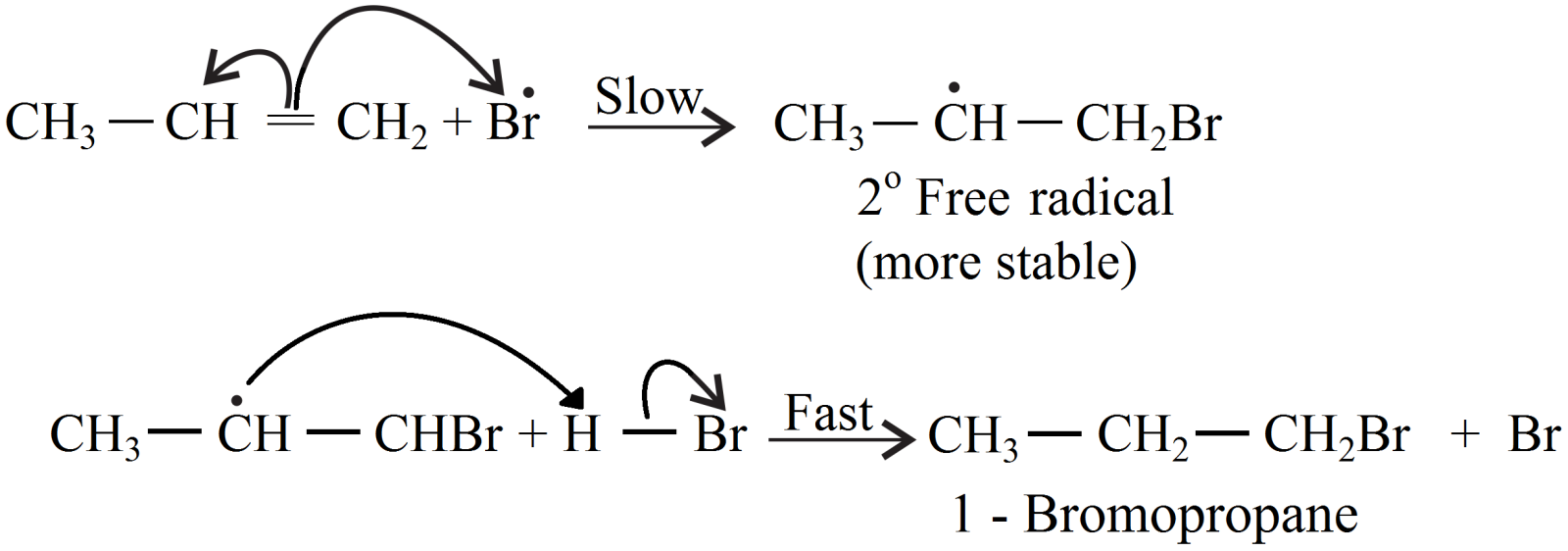
In presence of benzoyl peroxide, the reaction is still electrophilic but the electrophile here is a Br free radical which is obtained by the action of benzoyl peroxide on HBr.

In the first step, Br radical adds to propene in such a way so as to generate the more stable 2° free radical. In the second step, the free radical thus obtained rapidly abstracts a hydrogen atom from HBr to give 1-bromopropane.

From the above discussion, it is evident that although both reactions are electrophilic addition reactions but it is due to different order of addition of H and Br atoms which gives different products.

Need a full question paper?

Generate a complete, print-ready paper with questions like this in minutes — across 16+ boards, with answer keys.
Start Generating Free

Similar questions

Discuss the trend of the following:
The solubility and the nature of oxides, of Group 2 elements.
How much copper can be obtained from 100 g of copper sulphate $\left(\mathrm{CuSO}_4\right) ?$
If B-Cl bond has a dipole moment, explain why $BCl_3$ molecule has zero dipole moment.
Explain with the help of suitable example polar covalent bond.
Using electron transfer concept, identify the oxidant and reductant in the following redox reactions.
  1. $\text{Zn(s)}+2\text{H}^+\text{(aq)}\xrightarrow{\ \ \ \ \ \ \ \ \ }\text{Zn}^{2+}\text{(aq)}+\text{H}_2\text{(g)}$
  2. $2[\text{Fe}(\text{CN})_6]^{4-}\text{(aq)}+\text{H}_2\text{O}_2\text{(aq)}+2\text{H}^+\text{(aq)}\\\xrightarrow{\ \ \ \ \ \ }2[\text{Fe}\text{(CN)}_6]^{3-}\text{(aq)}+2\text{H}_2\text{O}\text{(l)}$
  3. $2[\text{Fe(CN)}_6]^{3-}\text{(aq)}+2\text{OH}^-\text{(aq)}+\text{H}_2\text{O}_2(\text{aq})\\\xrightarrow{\ \ \ \ \ \ \ \ }2[\text{Fe(CN)}_6]^{4-}\text{(aq)}+\text{O}_2 (\text{g}) +2\text{H}_2\text{(l)}$
  4. $\text{BrO}^-_3\text{(aq)}+\text{F}_2\text{(g)}+\text{2OH}^-\text{(aq)}\xrightarrow{\ \ \ \ \ \ \ \ }\\\text{BrO}^-_4\text{(aq)}+\text{F}^-\text{(aq)}+\text{H}_2\text{O(l)}$
  5. $2\text{NaClO}_3(\text{aq})+\text{I}_2\text{(aq)}\xrightarrow{\ \ \ \ \ \ \ }\text{2NaIO}_3\text{(aq)}+\text{Cl}_2\text{(g)}$
1. For each of the following compounds, write a condensed formula and also their bond-line formula.
Image
2. How does
i. an electron withdrawing group (EWG) and
ii. an electron donating group (EDG) influence the acid strength of carboxylic end?
Write the formulae of:
  1. Albite.
  2. Chile salt petre.
  3. Glauber's salt.
  4. Borax.
Explain briefly about the electrochemical series and give its main uses.
Draw a diagram of bubble plate type fractionating column. When do we require such type of a column for separating two liquids. Explain the principle involved in the separation of components of a mixture of liquids by using fractionating column. What industrial applications does this process have?
Match the species in Column I with the type of hybrid orbitals in Column II.
 
Column I
 
Column II
i.
Tetrahedral
a.
$\text{sp}^2$
ii.
Trigonal
b.
$\text{sp}$
iii.
Linear
c.
$\text{sp}^3$