Question
If B-Cl bond has a dipole moment, explain why $BCl_3$ molecule has zero dipole moment.

Answer

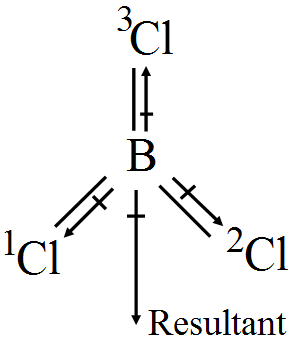
The dipole moment of any molecule is the vector sum total of each of the dipole moments. In $BCl_3$, molecule, although the B-Cl bonds individually are polar, the resultant dipole moment becomes zero.

We can see that the dipole moments of $B-^1Cl$ and $B-^2Cl$ produce a resultant which is equal in magnitude but opposite in direction to $B-^3Cl$ and hence cancels it out. That is why the net dipole moment of $BCl_3$, is zero.

Need a full question paper?

Generate a complete, print-ready paper with questions like this in minutes — across 16+ boards, with answer keys.
Start Generating Free

Similar questions

For any gaseous reaction how will you write the equilibrium constant $\left( K _{ p }\right)$ ? What is the relationship between $K_p$ and $K_{ c }$ ? Derive it.
What is meant by hybridisation of atomic orbitals? Describe the shapes of $sp, sp^2 , sp^3$ hybrid orbitals.
Describe various method to form alkane.
A certain salt X, gives the following results.
  1. Its aqueous solution is alkaline to litmus.
  2. It swells up to a glassy material Y on strong heating.
  3. When conc. $H_2SO_4$ is added to a hot solution of X, white crystal of an acid Z separates out.
Write equations for all the above reactions and identify X, Y and Z.
How many neutrons and protons are there in the following nuclei?
$\text{ }^{13}_{06}\text{C},\text{ }^{16}_{08}\text{O},\text{ }^{24}_{12}\text{Mg},\text{ }^{56}_{26}\text{Fe},\text{ }^{88}_{38}\text{Sr}$
How much volume of $0.1 \mathrm{M} \mathrm{~CH}_2\mathrm{COOH}$ should be added to 50 mL of $0.2 \mathrm{M} \mathrm{~CH}_3 \mathrm{COONa}$ solution to prepare a buffer solution of pH 4.91 . ( $\mathrm{pK}_{\mathrm{a}}$ of ACH is 4.76 ).
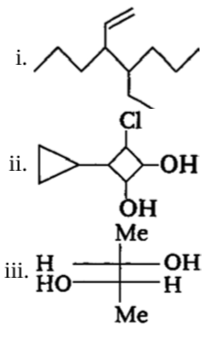
1. Give IUPAC names of the following structures.
Image
2. Benzoic acid is an organic compound. Its crude sample can be purified by crystallization from hot water. What characteristic differences in the properties of benzoic acid and the impurity make this process of purification suitable?
Describe the properties of covalent compounds.
Using electron transfer concept, identify the oxidant and reductant in the following redox reactions.
  1. $\text{Zn(s)}+2\text{H}^+\text{(aq)}\xrightarrow{\ \ \ \ \ \ \ \ \ }\text{Zn}^{2+}\text{(aq)}+\text{H}_2\text{(g)}$
  2. $2[\text{Fe}(\text{CN})_6]^{4-}\text{(aq)}+\text{H}_2\text{O}_2\text{(aq)}+2\text{H}^+\text{(aq)}\\\xrightarrow{\ \ \ \ \ \ }2[\text{Fe}\text{(CN)}_6]^{3-}\text{(aq)}+2\text{H}_2\text{O}\text{(l)}$
  3. $2[\text{Fe(CN)}_6]^{3-}\text{(aq)}+2\text{OH}^-\text{(aq)}+\text{H}_2\text{O}_2(\text{aq})\\\xrightarrow{\ \ \ \ \ \ \ \ }2[\text{Fe(CN)}_6]^{4-}\text{(aq)}+\text{O}_2 (\text{g}) +2\text{H}_2\text{(l)}$
  4. $\text{BrO}^-_3\text{(aq)}+\text{F}_2\text{(g)}+\text{2OH}^-\text{(aq)}\xrightarrow{\ \ \ \ \ \ \ \ }\\\text{BrO}^-_4\text{(aq)}+\text{F}^-\text{(aq)}+\text{H}_2\text{O(l)}$
  5. $2\text{NaClO}_3(\text{aq})+\text{I}_2\text{(aq)}\xrightarrow{\ \ \ \ \ \ \ }\text{2NaIO}_3\text{(aq)}+\text{Cl}_2\text{(g)}$
Discuss the chemistry of Lassaigne's test.