Question
Explain with the help of suitable example polar covalent bond.

Answer

When two atoms with different electronegativity are linked to each other by covalent bond, the shared electron pair will not in the centre because of the difference in electronegativity. For example, in hydrogen fluoride molecule, fluoride has greater electronegativity than hydrogen. Thus, the shared electron pair is displaced more towards’ fluorine atom, the later will acquire a partial negative charge $(\delta^+)$. At the same time hydrogen atom will have a partial positive charge $(\delta^-)$. Such a covalent bond is known as polar covalent bond or simply polar bond.
It is represented as $\ \ \ \delta^+\ \ \ \ \delta^-\\\ \ \text{H}\ -\ \text{F}\$2.1)\ (4.0)$

Need a full question paper?

Generate a complete, print-ready paper with questions like this in minutes — across 16+ boards, with answer keys.
Start Generating Free

Similar questions

  1. Heat(q) and work done (W) individually are not state functions but their sum is always a state function. Explain why?
  2. Calculate the standard enthalpy change $(\Delta_\text{r}\text{H}^\theta)$ and standard internal energy change $(\Delta_\text{r}\text{U}^\theta)$ for the following reaction at 300K:
$OF_2(g) + H_2O(g) + O_2(g) + 2HF(g)$
Standard enthalpy of formation $(\Delta_\text{r}\text{H}^\theta)$ of e n various species are given below:
$\Delta_\text{f}\text{H}^\theta\text{kJ mol}^{-1}: OF_2(g) = 23.0, H_2O(g)= -241.8, HF(g) = -268.6, R = 8.314 JK^{-1}mol^{-1}$.
Explain the structure of triple bond with diagram.
Calculate the degree of ionization of 0.05 M acetic acid if its $pK _{ a }$ value is 4.74 . How is the degree of dissociation affected when its solution also contains
a. 0.01 M
b. $0.1 M HCl ?$
i. An athlete is given 100 g of glucose of energy equivalent to 1560 kJ . He utilises $50 \%$ of this gained energy in the event. In order to avoid storage of energy in the body, calculate the weight of water that would need to perspire. The enthalpy of vaporisation of water is $44 kJ mol ^{-1}$.
ii. Compound with carbon-carbon double bond, such as ethylene, $C _2 H _4$, add hydrogen in a reaction called hydrogenation, $C _2 H _4(g)+ H _2(g) \rightarrow C _2 H _6(g)$
Calculate enthalpy change for the reaction, using the following combustion data,

$\text{C}_2\text{H}_4(\text{g})+3\text{O}_2(\text{g})\overrightarrow{\ \ \ \ \ }\ 2\text{CO}_2(\text{g})+2\text{H}_2\text{O(l)};$ $\Delta_\text{c}\text{H}^\circ=-1401\text{kJ mol}^{-1}\dots(\text{i})$

$\text{C}_2\text{H}_6(\text{g})+\frac{7}{2}\text{O}_2(\text{g})\overrightarrow{ \ \ \ \ \ \ \ }\ 2\text{CO}_2(\text{g})+3\text{H}_2\text{O(l)}$ $\Delta_\text{c}\text{H}^\circ=-1550\text{kJ mol}^{-1}\dots(\text{ii})$

$\text{H}_2(\text{g})+\frac{1}{2}\text{O}_2(\text{g})\overrightarrow{ \ \ \ \ }\ \text{H}_2\text{O(l)};$ $\Delta_\text{c}\text{H}^\circ=-286.0\text{kJ mol}^{-1}\dots(\text{iii})$
Discuss the trend of the following:
The solubility and the nature of oxides, of Group 2 elements.
Which elements have the following electronic configurations? (Use only the periodic table.)
i. $1 s^2, 2 s^2, 2 p^5$
ii. $[\operatorname{Ar}] 4 s^2, 3 d^{10}, 4 p ^1$
iii. $[ Xe ] 6 s^2$
iv. $[ Xe ] 6 s^2, 5 d^1, 4 f ^7$
v. $[ Ar ] 4 s^1, 3 d^{10}$ (exception to rules)
Discuss briefly de-mineralisation of water by ion exchange resin.
Derive the relationship between equilibriumconstant (K), reaction constant (Q) and Gibbs energy (G) and explain spontaneity of reaction with help of it.
Why is benzene extra ordinarily stable though it contains three double bonds?
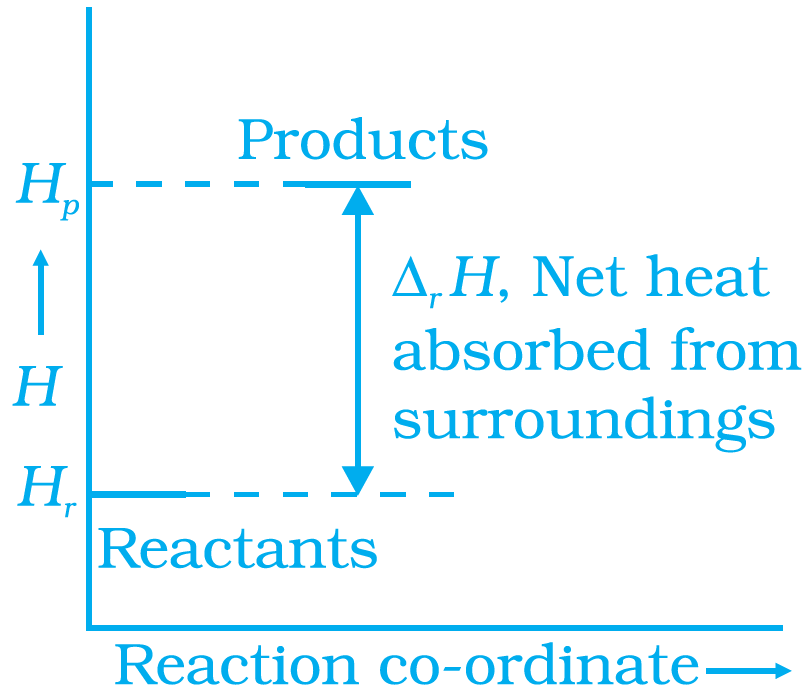
Enthalpy diagram for a particular reaction is given in Fig. Is it possible to decide spontaneity of a reaction from given diagram. Explain.