MCQ
Advantage of optical fibre
  • A
    High bandwidth and $EM$ interference
  • B
    Low bandwidth and $EM$ interference
  • C
    High band width, low transmission capacity and no $EM$ interference
  • High bandwidth, high data transmission capacity and no $EM$ interference

Answer

Correct option: D.
High bandwidth, high data transmission capacity and no $EM$ interference
d
(d) Few advantages of optical fibres are that the number of signals carried by optical fibres is much more than that carried by the Cu wire or radio waves. Optical fibres are practically free from electromagnetic interference and problem of cross talks whereas ordinary cables and microwave links suffer a lot from it.

Need a full question paper?

Generate a complete, print-ready paper with questions like this in minutes — across 16+ boards, with answer keys.

Start Generating Free

Similar questions

Transverse wave propagates in a medium with a velocity of $1450\,m/s$ . The distance between the nearest points at which the oscillations of the particles carried in the opposite phase $\pi $ is $0.1\,m$ . What is the frequency of the wave ..... $Hz$ ?
The ratio of the intensity at the centre of a bright fringe to the intensity at a point one-quarter of the distance between two fringe from the centre is
A convex lens (of focal length $20\, cm$) and a concave mirror, having their principal axes along the same lines, are kept $80\, cm$ apart from each other. The concave mirror is to the right of the convex lens. When an object is kept at a distance of $30\, cm$ to the left of the convex lens, its image remains at the same position even if the concave mirror is removed. The maximum distance of the object for which this concave mirror, by itself would produce a virtual image would be.....$cm$
A metal wire having Poisson's ratio $1 / 4$ and Young's modulus $8 \times 10^{10} \,N / m ^2$ is stretched by a force, which produces a lateral strain of $0.02 \%$ in it. The elastic potential energy stored per unit volume in wire is $[$in $J / m ^3]$
When two identical capacitors are charged individually to different potentials and connected parallel to each other, after disconnecting them from the source :
Two equally charged, identical metal spheres $A$ and $B$ repel each other with a force '$F$'. The spheres are kept fixed with a distance '$r$' between them. A third identical, but uncharged sphere $C$ is brought in contact with $A$ and then placed at the mid-point of the line joining $A$ and $B$. The magnitude of the net electric force on $C$ is
 A cell having an emf $\varepsilon$ and internal resistance $r$ is connected across a variable external resistance $R.$ As the resistance $R$ is increased, the plot of potential difference $V$ across $R$ is given by
It is found that if a neutron suffers an elastic collinear collision with deuterium at rest, fractional loss of its energy is $p_d $ ; while for its similar collision with carbon nucleus at rest, fractional loss of energy is $P_c$. The values of $P_d$ and $P_c$ are respectively
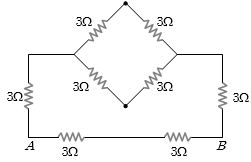
Equivalent resistance between $A$ and $B$ will be ............ $ohm$
Which of the following is not a correct statement