Ajet of water having velocity $=$ $10 $ $m/s$ and stream cross-section $=$ $2$ $cm^2$ hits a flat plate perpendicularly, with the water splashing out parallel to plate. The plate experiences a force of ....... $N$
Diffcult
Download our app for free and get started
Force $=$ change is linear momentum
$F=\frac{m v}{t} \Rightarrow F=\frac{V}{t} \times \rho \times v \Rightarrow F=a . v . \rho . v \Rightarrow F=a \rho v^{2}$
$F=2 \times 10^{-4} \times 1000 \times(10)^{2} \Rightarrow F=20 N$

Download our appand get started for free
Experience the future of education. Simply download our apps or reach out to us for more information. Let's shape the future of learning together!No signup needed.*
Similar Questions
- 1A boy has $60\, kg$ weight. He wants to swim in a river with the help of a wooden log. If relative density of wood is $0.6$, what is the minimum volume of wooden log? (density of river water is $1000\, kg/m^3$)View Solution
- 2View SolutionCorrect Bernoulli's equation is (symbols have their usual meaning) :
- 3A large tank filled with water to a height ‘h’ is to be emptied through a small hole at the bottom. The ratio of time taken for the level of water to fall from $ h$ to $\frac{h}{2}$ and from $\frac{h}{2}$ to zero isView Solution
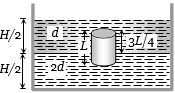
- 4A homogeneous solid cylinder of length $L$$(L < H/2)$. Cross-sectional area $A/5$ is immersed such that it floats with its axis vertical at the liquid-liquid interface with length $L/4$ in the denser liquid as shown in the fig. The lower density liquid is open to atmosphere having pressure ${P_0}$. Then density $D$ of solid is given byView Solution
- 5Air is streaming past a horizontal air plane wing such that its speed in $ 120 m/s$ over the upper surface and $ 90 m/s$ at the lower surface. If the density of air is $1.3 kg$ per $metre^3 $ and the wing is $10 m $ long and has an average width of $2 m$, then the difference of the pressure on the two sides of the wing of ....... $Pascal$View Solution
- 6View SolutionGauge pressure ........
- 7What is the pressure on a swimmer $20 \,m$ below the surface of water ........ $atm$View Solution
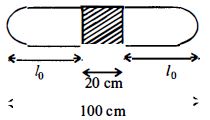
- 8A thin tube sealed at both ends is $100\, cm$ long. It lies horizontally, the middle $20\, cm$ containing mercury and two equal ends containing air at standard atmospheric pressure . If the tube is now turned to a vertical position, by what amount will the mercury be displaced ? (Given : cross-section of the tube can be assumed to be uniform) ........ $cm$View Solution
- 9View SolutionAn ice block contains a glass ball when the ice melts within the water containing vessel, the level of water
- 10A small sphere of radius $r$ falls from rest in a viscous liquid. As a result, heat is produced due to viscous force. The rate of production of heat when the sphere attains its terminal velocity, is proportional toView Solution