A boy has $60\, kg$ weight. He wants to swim in a river with the help of a wooden log. If relative density of wood is $0.6$, what is the minimum volume of wooden log? (density of river water is $1000\, kg/m^3$)
AIIMS 2010, Medium
Download our app for free and get started
Archimedes principal states that weight of body displaced by $liquid=upthrust.$
$60 \times g + V \times 0.6 \times {10^3}\,g = V \times 1000\,g$
$60 + 600\,V = 1000V$
$60 = 400V$
$V = \frac{{60}}{{400}} = \frac{3}{{20}}{m^3}$
Where, $V$ is the volume of wooden log.

Download our appand get started for free
Experience the future of education. Simply download our apps or reach out to us for more information. Let's shape the future of learning together!No signup needed.*
Similar Questions
- 1Two capillaries of same length and radii in the ratio $1 : 2$ are connected in series. A liquid flows through them in streamlined condition. If the pressure across the two extreme ends of the combination is $ 1 m$ of water, the pressure difference across first capillary is...... $m$View Solution
- 2View SolutionWith rise in temperature, density of a given body changes according to one of the following relations
- 3Water falls down a $500.0 \,m$ shaft to reach a turbine which generates electricity. ................ $m^3$ water must fall per second in order to generate $1.00 \times 10^9 \,W$ of power ? (Assume $50 \%$ efficiency of conversion and $\left.g=10 \,ms ^{-2}\right)$View Solution
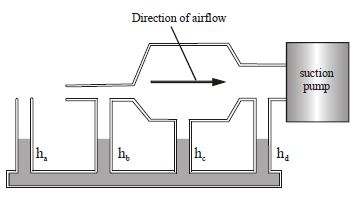
- 4Rank in order, from highest to lowest, the liquid heights $h_a$ to $h_d$ .The air flow is from left to right. The liquid columns are not drawn to scaleView Solution
- 5The pressure acting on a submarine is $3 \times 10^{5}\;Pa$ at a certain depth. If the depth is doubled, the percentage increase in the pressure acting on the submarine would be: (Assume that atmospheric pressure is $1 \times 10^{5} \;Pa$ density of water is $10^{3}\, kg \,m ^{-3}, g =10 \,ms ^{-2}$ )View Solution
- 6Water is flowing through a tube of non-uniform cross-section. Ratio of the radius at entry and exit end of the pipe is $3$ : $2$. Then the ratio of velocities at entry and exit of liquid isView Solution
- 7Acylindrical vessel open at the top is $20$ $cm$ high and $10$ $cm$ in diameter.Acircular hole whose cross-sectional area $1$ $cm^2$ is cut at the centre of the bottom of the vessel. Water flows from a tube above it into the vessel at the rate $100$ $cm^3s^{^{-1}}$. The height of water in the vessel under steady state is ....... $cm$ (Take $g=1000 $ $ cms^{^{-2}})$View Solution
- 8Two solids $A$ and $ B$ float in water. It is observed that $A$ floats with $\frac{1}{2}$ of its body immersed in water and $ B$ floats with $\frac{1}{4}$ of its volume above the water level. The ratio of the density of $ A$ to that of $B$ isView Solution
- 9Pressure at the bottom of a tank of water is $3P$, where $P$ is atmospheric pressure. If water is drawn out till the level of water is lowered by one fifth, then the pressure at the bottom of the tank isView Solution
- 10$Assertion :$ A thin stainless steel needle can lay floating on a still water surface.View Solution
$Reason :$ Any object floats when the buoyancy force balances the weight of the object