MCQ
All of the following statements are correct except
  • A
    The total length of an astronomical telescope is the sum of the focal lengths of its two lenses
  • The image formed by the astronomical telescope is always erect because the effect of the combination of the two lenses is divergent
  • C
    The magnification of an astronomical telescope can be increased by decreasing the focal length of the eye-piece
  • D
    The magnifying power of the refracting type of astronomical telescope is the ratio of the focal length of the objective to that of the eye-piece
Answer

Correct option: B.
The image formed by the astronomical telescope is always erect because the effect of the combination of the two lenses is divergent
b
(b) Final image formed by astronomical telescope is inverted not erect.

Need a full question paper?

Generate a complete, print-ready paper with questions like this in minutes — across 16+ boards, with answer keys.

Start Generating Free

Similar questions

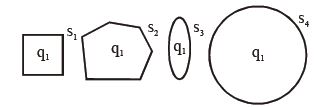
Electric flux through surface $s_1$
A condenser having a capacity of $6\,\mu F$ is charged to $100\, V$ and is then joined to an uncharged condenser of $14\,\mu F$ and then removed. The ratio of the charges on $6\,\mu F$ and $14\,\mu F$ and the potential of $6\,\mu F$ will be
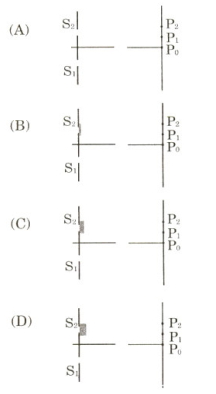
Column $I$ shows four situations of standard Young's double slit arrangement with the screen placed far away from the slits $S_1$ and $S_2$. In each of these cases $\mathrm{S}_1 \mathrm{P}_0=\mathrm{S}_2 \mathrm{P}_0, \mathrm{~S}_1 \mathrm{P}_1-\mathrm{S}_2 \mathrm{P}_1=\lambda / 4$ and $\mathrm{S}_1 \mathrm{P}_2-\mathrm{S}_2 \mathrm{P}_2=\lambda / 3$, where $\lambda$ is the wavelength of the light used. In the cases $\mathrm{B}, \mathrm{C}$ and $\mathrm{D}$, a transparent sheet of refractive index $\mu$ and thickness $t$ is pasted on slit $\mathrm{S}_2$. The thicknesses of the sheets are different in different cases. The phase difference between the light waves reaching a point $\mathrm{P}$ on the screen from the two slits is denoted by $\delta(\mathrm{P})$ and the intensity by $I(\mathrm{P})$. Match each situation given in Column $I$ with the statement$(s)$ in Column $II$ valid for that situation.

Column $I$ Column $II$
$(A)$ $Image$ $(p)$ $\delta\left(\mathrm{P}_0\right)=0$
$(B)$ $(\mu-1) t=\lambda / 4$ $Image$ $(q)$ $\delta\left(\mathrm{P}_1\right)=0$

$(C)$ $(\mu-1) t=\lambda / 2$ $Image$

$(r)$ $I\left(\mathrm{P}_1\right)=0$
$(D)$ $(\mu-1) t=3 \lambda / 4$ $Image$ $(s)$ $\left(\mathrm{P}_0\right)>I\left(\mathrm{P}_1\right)$
  $(t)$ $I\left(\mathrm{P}_2\right)>I\left(\mathrm{P}_1\right)$

Assertion : $NAND$ or $NOR$ gates are called digital building blocks.

Reason : The repeated use of $NAND$ (or $NOR$) gates can produce all the basis or complicated gates.

The amplification factor of a triode valve is $15$. If the grid voltage is changed by $0.3 \,volt$  the change in plate voltage in order to keep the plate current constant (in volt) is
Huygen's concept of wavelets is useful in:
Two small metal balls of different masses $m_1$ and $m_2$ are connected by strings of equal length to a fixed point. When the balls are given equal charges, the angles that the two strings make with the vertical are $30^{\circ}$ and $60^{\circ}$, respectively. The ratio $m_1 / m_2$ is close to
A horse-shoe magnet is an example of $.......$
An electron enters a magnetic field whose direction is perpendicular to the velocity of the electron. Then
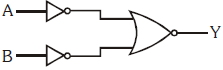
For the logic circuit shown, the truth table is :