$\alpha$ particle is revolving in radius $r$ with frequency $f$ then find value of magnetic dipole moment.
AIIMS 2019, Medium
Download our app for free and get started
The magnetic dipole moment is calculated as,
$M=i \times \pi r^{2}$
$=\frac{2 e}{2 \pi r} \times v \times \pi r^{2}$
$=\frac{2 e v r}{2}$
$=e v r$

Download our appand get started for free
Experience the future of education. Simply download our apps or reach out to us for more information. Let's shape the future of learning together!No signup needed.*
Similar Questions
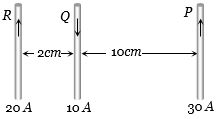
- 1Three long, straight and parallel wires carrying currents are arranged as shown in figure. The force experienced by $10\, cm$ length of wire $Q$ isView Solution
- 2View SolutionA current flows in a conductor from east to west. The direction of the magnetic field at a points above the conductor is .....
- 3An ammeter gives full scale deflection when current of $1.0\, A$ is passed in it. To convert it into $10\, A$ range ammeter, the ratio of its resistance and the shunt resistance will beView Solution
- 4Two long conductors, separated by a distance $d$ carry current $I_1$ and $I_2$ in the same direction. They exert a force $F$ on each other. Now the current in one of them is increased to two times and its directions is reversed. The distance is also increased to $3d$. The new value of the force between them isView Solution
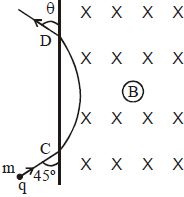
- 5A particle of mass $m = 1.67 \times 10^{-27}\, kg$ and charge $q = 1.6 \times 10^{-19} \, C$ enters a region of uniform magnetic field of strength $1$ $tesla$ along the direction shown in the figure. The speed of the particle is $10^7\, m/s.$ The magnetic field is directed along the inward normal to the plane of the paper. The particle enters the field at $C$ and leaves at $D.$ Then the angle $\theta$ must be :-.........$^o$View Solution
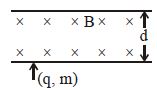
- 6As shown in the figure, the uniform magnetic field between the two identical plates is $B$. There is a hole in plate. If through this hole a particle of charge $q$, mass $m$ and energy $E$ enters this magnetic field, then the particle will not collide with the upper plate providedView Solution
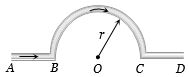
- 7In the figure, shown the magnetic induction at the centre of there $arc$ due to the current in portion $AB$ will beView Solution
- 8A coil having $N$ turns is wound tightly in the form of a spiral with inner and outer radii $a$ and $b$ respectively. When a current $i$ passes through the coil, the magnetic field at the centre isView Solution
- 9A current carrying long solenoid is placed on the ground with its axis vertical. A proton is falling along the axis of the solenoid with a velocity $v$. When the proton enters into the solenoid, it willView Solution
- 10A charge particle moving in magnetic field $B$, has the components of velocity along $B$ as well as perpendicular to $B$. The path of the charge particle will beView Solution