Question
Among the following structures, select $E$ isomers (arrows indicate the bonds to be considered) ?

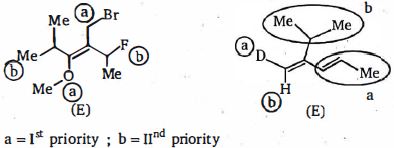
Generate a complete, print-ready paper with questions like this in minutes — across 16+ boards, with answer keys.
$Cu^+ /Cu = + 0.52\, V$,
$Fe^{3+} /Fe^{2+} = +0.7 7\, V$,
$\frac{1}{2}{I_2}\left( s \right)/{I^ - }\, = + 0.54\,V,$
$Ag^+ /Ag = + 0.88\,V$.
Based on the above potentials, strongest oxidizing agent will be
$2NO + 2H_2 \longrightarrow N_2 + 2H_2O$
has following mechanism
Step $-I$ : $2NO \longrightarrow N_2O_2$
Step $-II$ : $N_2O_2 + H_2 \longrightarrow N_2O + H_2O$
Step $-III$ : $N_2O + H_2 \longrightarrow N_2 + H_2O$
Which of the following substance is a reaction intermediate
$(I)\,\,La(OH)_3$ is the least basic among hydroxides of lanthanides.
$(II) \,\,Zr^{4+}$ and $Hf^{4+}$ posses almost the same ionic radii.
$(III)\,\,Ce^{4+}$ can as an oxidizing agent
Which of the above is/are true ?
$[Image]$
$\left[ Ph\right.$ is $\left.- C _{6} H _{5}\right]$ is ....
$(A)\,\xrightarrow[{excess}]{{Me\, - \,I}}\,(C)\,\xrightarrow[{(ii)\,\,{H^ + }}]{{(i)\,\,NaN{H_2}}}(D)$
$A$. silica gel $B$. alumina $C$. quick lime $D$. magnesia
Choose the most appropriate answer from the options given below :