MCQ

An achromatic combination of lenses produce:

  • A
    Images in black and white
  • B
    Colored images
  • C
    Images unaffected by variation of refractive index with wavelength
  • D
    Highly enlarged images

Answer

  1. Images unaffected by variation of refractive index with wavelength

Explanation:

An achromatic combination of lenses provide deviation without dispersion. So, images are unaffected by variation of refractive index with wavelength.

Need a full question paper?

Generate a complete, print-ready paper with questions like this in minutes — across 16+ boards, with answer keys.

Start Generating Free

Similar questions

Two concave lenses L1 and L2 are kept in contact with each other. If the space between the two lenses is filled with a material of refractive index $\mu\approx1,$ the magnitude of the focal length of the combination:

A light has amplitude A and angle between analyser and polariser is 60°. Light is reflected by analyser has amplitude

(a) A 

(b) A/ 

(c) A/2

(d) A/2

A metallic resistor is connected across a battery. If the number of collisions of the free electrons with the lattice is somehow decreased in the resistor (for example, by cooling it), the current will:
  1. Increase.
  2. Decrease.
  3. Remain constant.
  4. Become zero.
A positively charged particle projected towards east is deflected towards north by a magnetic field. The field may be:
  1. Towards west.
  2. Towards south.
  3. Upward.
  4. Downward.

The following four wires are made of the same material and are at the same temperature. Which one of them has highest electrical resistance

(a) Length = 50 cm, diameter = 0.5 mm

(b) Length = 100 cm, diameter = 1 mm

(c) Length = 200 cm, diameter = 2 mm

(d) Length = 300 cm, diameter = 3 mm

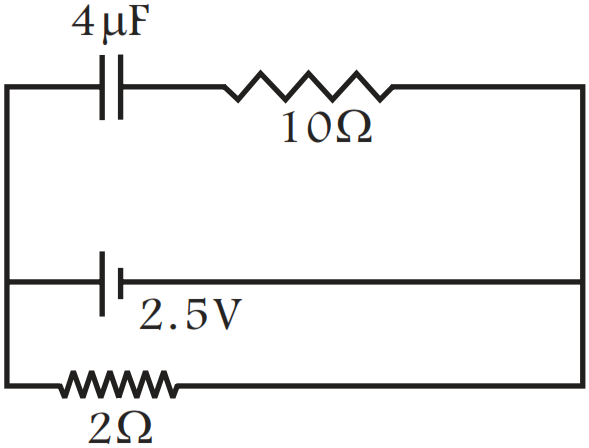
A capacitor of 4μ F is connected as shown in the circuit (Fig.). The internal resistance of the battery is 0.5Ω. The amount of charge on the capacitor plates will be:

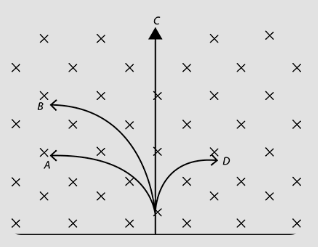
A neutron, a proton, an electron and an α−particle enter a region of uniform magnetic field with equal velocities. The magnetic field is perpendicular to the plane of paper and directed into it. The tracks of particles are labeled in the figure. The neutron follows the track:

The rays of different colours fail to converge at a point after going through a converging lens. This defect is called:
A solid sphere, a hollow sphere and a disc, all having same mass and radius, are placed at the top of an incline and released. The friction coefficients between the objects and the incline are same and not sufficient to allow pure rolling. Least time will be taken in reaching the bottom by:
  1. The solid sphere.
  2. The hollow sphere.
  3. The disc.
  4. All will take same time.
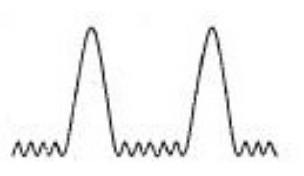
The figure shows diffraction pattern of two nearby points. The two points are: