An aeroplane of mass $3 \times 10^4\, kg$ and total wing area of $120\, m^2$ is in a level flight at some height. The difference in pressure between the upper and lower surfaces of its wings in kilopascals is $(g=10\,m/s^2)$
Easy


Download our appand get started for free
Experience the future of education. Simply download our apps or reach out to us for more information. Let's shape the future of learning together!No signup needed.*
Similar Questions
- 1A hollow cone floats with its axis vertical upto one-third of its height in a liquid of relative density $0.8$ and with its vertex submerged. When another liquid of relative density $\rho$ is filled in it upto one-third of its height, the cone floats upto half its vertical height. The height of the cone is $0.10$ $m$ and the radius of the circular base is $0.05$ $m$. The specific gravity $\rho$ is given byView Solution
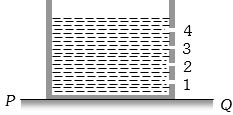
- 2A cylindrical vessel of $90 cm$ height is kept filled upto the brim. It has four holes $ 1, 2, 3, 4$ which are respectively at heights of $20 cm, 30 cm, 45 cm $ and $50 cm$ from the horizontal floor $PQ.$ The water falling at the maximum horizontal distance from the vessel comes fromView Solution
- 3Three identical vessels are filled with equal masses of three different liquids $A, B$ and $C$ $({\rho _A} > {\rho _B} > {\rho _C})$. The pressure at the base will beView Solution
- 4A small ball of mass $M$ and density $\rho$ is dropped in a viscous liquid of density $\rho_0$. After some time, the ball falls with a constant velocity. What is the viscous force on the ball ?View Solution
- 5Two small spherical metal balls, having equal masses, are made from materials of densities $\rho_{1}$ and $\rho_{2}\left(\rho_{1}=8 \rho_{2}\right)$ and have radii of $1\; \mathrm{mm}$ and $2\; \mathrm{mm}$, respectively. They are made to fall vertically (from rest) in a viscous medum whose coefficient of viscosity equals $\eta$ and whose denstry is $0.1 \mathrm{\rho}_{2} .$ The ratio of their terminal velocitites would beView Solution
- 6Water is flowing continuously from a tap having an internal diameter $8 \times 10^{-3}\ m $ The water velocity as it leaves the tap is $0.4$ $ms^{-1}$ છે. The diameter of the water stream at a distance $2 \times 10^{-1}$ $m$ below the tap is close to .......$\times 10^{-3}\;m$View Solution
- 7View SolutionThe weight of an aeroplane flying in air is balanced by
- 8A flat plate of area $0.1 \,m ^2$ is placed on a flat surface and is separated from it by a film of oil $10^{-5} \,m$ thick whose coefficient of viscosity is $1.5 N \,sm s ^{-2}$. The force required to cause the plate to slide on the surface at constant speed of $1 \,mm s ^{-1}$ is ............ $N$View Solution
- 9Assume that, the drag force on a football depends only on the density of the air, velocity of the ball and the cross-sectional area of the ball. Balls of different sizes but the same density are dropped in an air column. The terminal velocity reached by balls of masses $250 \,g$ and $125 \,g$ are in the ratioView Solution
- 10The velocity of a small ball of mass $0.3\,g$ and density $8\,g / cc$ when dropped in a container filled with glycerine becomes constant after some time. If the density of glycerine is $1.3\,g / cc$, then the value of viscous force acting on the ball will be $x \times 10^{-4}\,N$, the value of $x$ is [use $g=10\,m / s ^{2}$ ]View Solution