A flat plate of area $0.1 \,m ^2$ is placed on a flat surface and is separated from it by a film of oil $10^{-5} \,m$ thick whose coefficient of viscosity is $1.5 N \,sm s ^{-2}$. The force required to cause the plate to slide on the surface at constant speed of $1 \,mm s ^{-1}$ is ............ $N$
Easy
Download our app for free and get started
(b)
$F=\eta A \frac{v}{l}$
Substituting values,
$=1.5 \times 0.1 \times \frac{1 \times 10^{-3}}{10^{-5}}$
$=15 \,N$

Download our appand get started for free
Experience the future of education. Simply download our apps or reach out to us for more information. Let's shape the future of learning together!No signup needed.*
Similar Questions
- 1The Bhagirathi and the Alaknanda merge at Deoprayag to form the Ganga with their speeds in the ratio $1: 1: 5$. The cross-sectional areas of the Bhagirathi, the Alaknanda and the Ganga are in the ratio $1: 2: 3$. Assuming streamline flow, the ratio of the speed of Ganga to that of the Alaknanda isView Solution
- 2View SolutionA wooden piece floats half submerged in a tub of water. If the system is transferred to a lift ascending with acceleration the wooden piece will
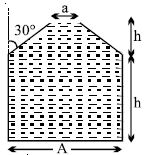
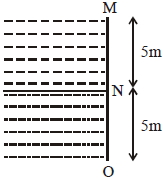
- 3Two liquids of densities $\rho_{1}$ and $\rho_{2}\left(\rho_{2}=2 \rho_{1}\right)$ are filled up behind a square wall of side $10\; \mathrm{m}$ as shown in figure. Each liquid has a height of $5 \;\mathrm{m} .$ The ratio of the forces due to these liquids exerted on upper part $MN$ to that at the lower pait $NO$ is (Assume that the liquids are not mixing)View Solution
- 4Water is filled to a height $H$ behind a dam of width $w$. The resultant force on dam is ..............View Solution
- 5View SolutionWater falls from a tap, down the streamline
- 6View SolutionA cork is submerged in water by a spring attached to the bottom of a bowl. When the bowl is kept in an elevator moving with acceleration downwards, the length of spring
- 7A cylindrical vessel of cross-section $A$ contains water to a height $h$ . There is a hole in the bottom of radius $'a'$ . The time in which it will be emptied isView Solution
- 8$Assertion : $ Machine parts are jammed in winter.View Solution
$Reason :$ The viscosity of lubricant used in machine parts increase at low temperatures. - 9Ajet of water having velocity $=$ $10 $ $m/s$ and stream cross-section $=$ $2$ $cm^2$ hits a flat plate perpendicularly, with the water splashing out parallel to plate. The plate experiences a force of ....... $N$View Solution
- 10The vessel shown in the figure has two sections. The lower part is a rectangular vessel with area of cross-section $A$ and height $h$. The upper part is a conical vessel of height $h$ with base area $‘A’$ and top area $‘a’$ and the walls of the vessel are inclined at an angle $30^o$ with the vertical.A liquid of density $\rho$ fills both the sections upto a height $2h$. Neglecting atmospheric pressure.View Solution