An aeroplane of mass $3 \times 10^4\,kg$ and total wing area of $120\,m^2$ is in a level flight at some height. The difference in pressure between the upper and lower surfaces of its wings in kilopascals is........... $kPa$ $(g=10\,m/s^2)$
Medium


Download our appand get started for free
Experience the future of education. Simply download our apps or reach out to us for more information. Let's shape the future of learning together!No signup needed.*
Similar Questions
- 1In Guericke's experiment to show the effect of atmospheric pressure, two copper hemispheres were tightly fitted to each other to form a hollow sphere and the air from the sphere was pumped out to create vacuum inside. If the radius of each hemisphere is $R$ and the atmospheric pressure is $p$, then the minimum force required (when the two hemispheres are pulled apart by the same force) to separate the hemispheres isView Solution
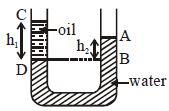
- 2In a $U-$ tube experiment, a column $AB$ of water is balanced by a column $‘CD’$ of oil, as shown in the figure. Then the relative density of oil isView Solution
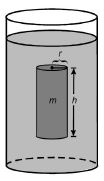
- 3A right circular cylinder has a mass $m$, radius $r$, and a height $h$. The cylinder is completely submerged in a fluid of density $\rho$, as shown in the diagram. What is the magnitude of the net force on the cylinder?View Solution
- 4A ball of density $'\rho '$ is released from deep inside of a viscous liquid of density $'2\rho '$ . It will move upView Solution
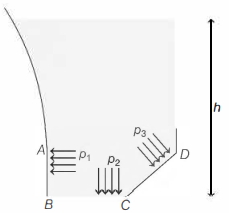
- 5A tall tank filled with water has an irregular shape as shown. The wall $C D$ makes an angle of $45^{\circ}$ with the horizontal, the wall $A B$ is normal to the base $B C$. The lengths $A B$ and $C D$ are much smaller than the height $h$ of water (figure not to scale). Let $p_1, p_2$ and $p_3$ be the pressures exerted by the water on the wall $A B$, base $B C$ and the wall $C D$ respectively. Density of water is $\rho$ and $g$ is acceleration due to gravity. Then, approximatelyView Solution
- 6A sphere is dropped under gravity through a fluid of viscosity $\eta$ . If the average acceleration is half of the initial acceleration, the time to attain the terminal velocity is ($\rho$ = density of sphere ; $r$ = radius)View Solution
- 7A uniform cylinder of length $L$ and mass $M$ having crosssectional area $A$ is suspended, with its length vertical, from a fixed point by a massless spring such that it is half submerged in a liquid of density $\sigma$ at equilibrium position. The extension $x_0$ of the spring when it is in equilibrium isView Solution
- 8The velocity of a small ball of mass $\mathrm{M}$ and density $d,$ when dropped in a container filled with glycerine becomes constant after some time. If the density of glycerine is $\frac{\mathrm{d}}{2}$, then the viscous force acting on the ball will be :View Solution
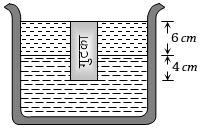
- 9A cubical block of wood $10 \,cm$ on a side floats at the interface between oil and water with its lower surface horizontal and $4\, cm$ below the interface. The density of oil is $0.6gc{m^{ - 3}}$. The mass of block is ...... $gm$View Solution
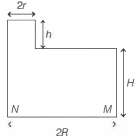
- 10A cylindrical vessel of base radius $R$ and height $H$ has a narrow neck of height $h$ and radius $r$ at one end (see figure). The vessel is filled with water (density $\rho_w$ ) and its neck is filled with immiscible oil (density $\rho_0$ ). Then, the pressure atView Solution