Question
An alkane has a molecular mass of 72. Give all the possible structural isomers along with their IUPAC names.

Answer

The general formula of alkanes is $\text{C}_\text{n}\text{H}_{2\text{n}+2}\Rightarrow$ 12 × n + 1 × (2n + 2) = 72 or 12n + 2n + 2 = 72 or n = 5
Thus, the molecular formula of the alkane is $\mathrm{C}_5 \mathrm{H}_{12}$.
  1. $\text{CH}_3-\text{CH}_2-\text{CH}_2-\text{CH}_2-\text{CH}_2-\text{CH}_3\\ \ \ \ \ \ \ \ \ \ \ \ \ \ \ \ \ \ \ \ \ \ _{\text{n-hexane}}$
  2. $\text{CH}_3-\text{CH}-\text{CH}_2-\text{CH}_2-\text{CH}_3\\ \ \ \ \ \ \ \ \ \ \ \ \ \ |\\ \ \ \ \ \ \ \ \ \ \ \ \ \ \text{CH}_3\\ \ \ \ \ \ \ \ \ \ _{2-\text{methylpentane}}$
  3. $\text{CH}_3-\text{CH}_2-\text{CH}-\text{CH}_2-\text{CH}_3\\ \ \ \ \ \ \ \ \ \ \ \ \ \ \ \ \ \ \ \ \ \ \ \ \ \ \ |\\ \ \ \ \ \ \ \ \ \ \ \ \ \ \ \ \ \ \ \ \ \ \ \ \ \ \text{CH}_3\\ \ \ \ \ \ \ \ \ \ \ _{3-\text{methylpentane}}$
  4. $\text{CH}_3-\text{CH}-\text{CH}-\text{CH}_3\\ \ \ \ \ \ \ \ \ \ \ \ \ \ |\ \ \ \ \ \ \ \ \ \ |\\ \ \ \ \ \ \ \ \ \ \ \ \ \text{CH}_3\ \ \ \ \text{CH}_3\\ \ \ \ \ _{2,\ 3-\text{dimethylbutane}}$
  5. $ \ \ \ \ \ \ \ \ \ \ \ \ \ \text{CH}_3\\ \ \ \ \ \ \ \ \ \ \ \ \ \ \ |\\\text{CH}_3-\text{C}-\text{CH}_2-\text{CH}_3\\ \ \ \ \ \ \ \ \ \ \ \ \ \ |\\ \ \ \ \ \ \ \ \ \ \ \ \ \text{CH}_3\\ \ \ \ \ \ _{2,\ 2-\text{dimethylbutane}}$

Need a full question paper?

Generate a complete, print-ready paper with questions like this in minutes — across 16+ boards, with answer keys.

Start Generating Free

Similar questions

Basic principle of hydrogen economy is transportation and storage of energy in the form of liquid or gaseous hydrogen. Which property of hydrogen may be useful for this purpose? Support your answer with the chemical equation if required.
Calculate the number of atoms in each of the following
1. 52 mole of Ar
2. 52 u of He
3. 52 g of He .
Melting point, enthalpy of vapourisation and viscosity data of $H_2O$ and $D_2O$ are given below:
 
$H_2O$
$D_2O$
Melting point / K
373.0
374.4
Enthalpy of vapourisation at $(373 K)/ kJ mol^{-1}$
40.66
41.61
Viscosity/ centipoise
0.8903
1.107
On the basis of this data, explain in which of these liquids intermolecular forces are stronger?
Threshold frequency, $v_0$ is the minimum frequency which a photon must possess to eject an electron from a metal. It is different for different metals. When a photon of frequency $1.0 \times 10^{15} \mathrm{~s}^{-1}$ was allowed to hit a metal surface, an electron having $1.988 \times 10^{-19}$ J of kinetic energy was emitted. Calculate the threshold frequency of this metal. Show that an electron will not be emitted if a photon with a wavelength equal to 600 nm hits the metal surface.
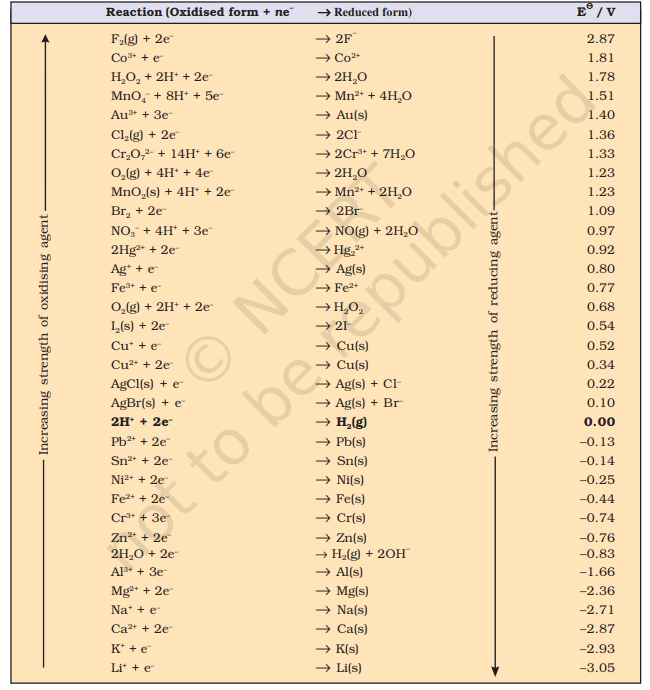
Using the standard electrode potentials given in the Table, predict if the reaction between the following is feasible:

$\mathrm{Br}_2(\mathrm{aq})$ and $\mathrm{Fe}^{2+}(\mathrm{aq})$
A cell is constructed using $\frac{\text{Cu}^{2+}}{\text{Cu}}$ and $\frac{\text{Al}^{3+}}{\text{Al}}$ electrodes.
  1. Identify cathode and anode.
  2. Write the reactions at anode, cathode and net cell reaction.
  3. Calculate $\text{E}^0_\text{cell}$
$\text{E}^0_\frac{\text{Al}^{3+}}{\text{Ag}}=-1.66\text{V}$

$\text{E}^0_\frac{\text{Cu}^{2+}}{\text{Cu}}=+0.34\text{V}$
Explain the following:
$Pb^{4+}$ acts as an oxidising agent but $Sn^{2+}$ acts as a reducing agent.
Name the electrophile/ nucleophile generated by following species:
i. $\mathrm{HNO}_3+\mathrm{H}_2 \mathrm{SO}_4$
ii. $\mathrm{CH}_3 \mathrm{COCl}$
iii. alc. KCN
  1. 300ml. of oxygen at-10°C are heated to 10°C. Find the volume of gas at 10°C if pressure is constant.
  2. Name the temperature at which density of water is maximum.
Define:
  1. Critical pressure.
  2. Critical volume and give their expressions.