An amine on reaction with benzenesulphonyl chloride produces a compound insoluble in alkaline solution. This amine can be prepared by ammonolysis of ethyl chloride. The correct structure of amine is
- A
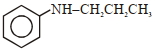
- B$CH _{3} CH _{2} NH _{2}$
- C$CH _{3} CH _{2} CH _{2} NHCH _{3}$
- D$C{H_3}C{H_2}C{H_2}\mathop N\limits^H - C{H_2}C{H_3}$
JEE MAIN 2021, Easy



Download our appand get started for free
Experience the future of education. Simply download our apps or reach out to us for more information. Let's shape the future of learning together!No signup needed.*
Similar Questions
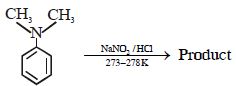
- 1View SolutionThe main product of following reaction will be
- 2In the reaction $A$ isView Solution

- 3The correct order of increasing basic nature for the bases $N{H_3},\,C{H_3}N{H_2}$ and ${(C{H_3})_2}NH$ isView Solution
- 4$C{H_3}N{O_2}\xrightarrow{{Sn + HCl}}C{H_3}X,$ the ‘$X$’ containView Solution
- 5View SolutionAmines behave as
- 6Number of isomeric primary amines obtained from ${C_4}{H_{11}}N$ areView Solution
- 7View SolutionAlkyl cyanides when react with Grignard reagent, the product on hydrolysis found, is
- 8View SolutionGabriel phthalamide synthesis is used for preparation of :-
- 9$p$-Amino- $N, N$-dimethylaniline is added to a strongly acidic solution of ${X}$. The resulting solution is treated with a few drops of aqueous solution of ${Y}$ to yield blue coloration due to the formation of methylene blue. Treatment of the aqueous solution of ${Y}$ with the reagent potassium hexacyanoferrate$(II)$ leads to the formation of an intense blue precipitate. The precipitate dissolves on excess addition of the reagent. Similarly, treatment of the solution of ${Y}$ with the solution of potassium hexacyanoferrate$(III)$ leads to a brown coloration due to the formation of ${Z}$.View Solution
$1.$ The compound ${X}$ is
$(A)$ $\mathrm{NaNO}_3$ $(B)$ $\mathrm{NaCl}$ $(C)$ $\mathrm{Na}_2 \mathrm{SO}_4$ $(D)$ $\mathrm{Na}_2 \mathrm{~S}$
$2.$ The compound ${Y}$ is
$(A)$ $\mathrm{MgCl}_2$ $(B)$ $\mathrm{FeCl}_2$ $(C)$ $\mathrm{FeCl}_3$ $(D)$ $\mathrm{ZnCl}_2$
$3.$ The compound ${Z}$ is
$(A)$ $\left.\mathrm{Mg}_2 \mid \mathrm{Fe}(\mathrm{CN})_6\right]$ $(B)$ $\operatorname{Fe}\left[\mathrm{Fe}(\mathrm{CN})_6\right]$
$(C)$ $\mathrm{Fe}_4\left[\mathrm{Fe}(\mathrm{CN})_6\right]_3$ $(D)$ $\mathrm{K}_2 \mathrm{Zn}_3\left[\mathrm{Fe}(\mathrm{CN})_6\right]_2$
Give the answer question $1,2$ and $3.$
- 10What is the expected order of reactivity of the following compounds in electrophilic chlorination $(Cl_2 + FeCl_3)$?View Solution
(more reactive $>$ less reactive)