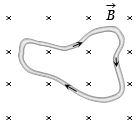
An arbitrary shaped closed coil is made of a wire of length $L$ and a current $I$ ampere is flowing in it. If the plane of the coil is perpendicular to magnetic field $\mathop B\limits^ \to $, the force on the coil is
Easy


Download our appand get started for free
Experience the future of education. Simply download our apps or reach out to us for more information. Let's shape the future of learning together!No signup needed.*
Similar Questions
- 1View SolutionA current carrying coil is subjected to a uniform magnetic field. The coil will orient so that its plane becomes
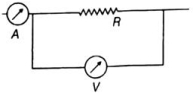
- 2In the adjoining circuit diagram, the readings of ammeter and voltmeter are $2\, A$ and $120 \,V$, respectively. If the value of $R$ is $75\, \Omega$, then the voltmeter resistance will be $\Omega$View Solution
- 3An electron enters a region where magnetic $(B)$ and electric $(E)$ fields are mutually perpendicular to one another, thenView Solution
- 4Two infinitely long parallel wires carry currents of magnitude $I_1$ and $I_2$ are at a distance $4 cm$ apart. The magnitude of the net magnetic field is found to reach a non-zero minimum value between the two wires and $1 \,cm$ away from the first wire. The ratio of the two currents and their mutual direction isView Solution
- 5In the following hexagons, made up of two different material $P$ and $Q,$ current enters and leaves from points $X$ and $Y$ respectively. In which case the magnetic field at its centre is not zero.View Solution
- 6Two ions of masses $4 \,{amu}$ and $16\, amu$ have charges $+2 {e}$ and $+3 {e}$ respectively. These ions pass through the region of constant perpendicular magnetic field. The kinetic energy of both ions is same. Then :View Solution
- 7View SolutionAn electron is travelling horizontally towards east. A magnetic field in vertically downward direction exerts a force on the electron along
- 8A galvanometer coil has a resistance of $12\,\Omega $ and meter shows full scale deftection for a current of $3\,mA$ then to convert it into a voltmeter of range $0\,-18\, V$ a resistance should be addedView Solution
- 9A current carrying small loop behaves like a small magnet. If $A$ be its area and $M$ its magnetic moment, the current in the loop will beView Solution
- 10A charge $q$ is moving in a magnetic field then the magnetic force does not depend uponView Solution