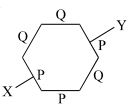
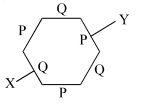
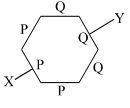
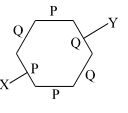
In the following hexagons, made up of two different material $P$ and $Q,$ current enters and leaves from points $X$ and $Y$ respectively. In which case the magnetic field at its centre is not zero.
- A
- B
- C
- D
Advanced


Download our appand get started for free
Experience the future of education. Simply download our apps or reach out to us for more information. Let's shape the future of learning together!No signup needed.*
Similar Questions
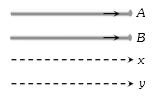
- 1$A$ and $B$ are two conductors carrying a current $i$ in the same direction. $x$ and $y$ are two electron beams moving in the same directionView Solution
- 2A voltmeter of resistance $1000\,\Omega $ gives full scale deflection when a current of $100\, mA$ flow through it. The shunt resistance required across it to enable it to be used as an ammeter reading $1\, A$ at full scale deflection is ............... $\Omega $View Solution
- 3A rectangular loop of wire shown below is coplanar with a long wire carrying current $I$. The loop is pulled to the right a s indicated. What are the directions of the induced current in the loop and the magnetic forces on the left and the right sides of the loop?View Solution
Induced current Force on left side Force on right side $a.$ Counter clockwise To the left To the right $b.$ clockwise To the left To the right $c.$ Counter clockwise To the right To the left $d.$ clockwise To the right To the left 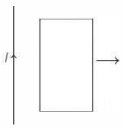
- 4Choose the correct sketch of the magnetic field lines of a circular current loop shown by the dot $ \odot $ and the cross $\otimes .$View Solution
- 5An imaginary north pole of $10\,Am$ is rotating around an infinite long current carrying wire with $30\,revolution/min.$ on circular path. If current in wire is $5\,A$ then workdone in one second in doing soView Solution
- 6In hydrogen atom, the electron is making $6.6 \times {10^{15}}\,rev/\sec $ around the nucleus in an orbit of radius $0.528\, \mathop A\limits^o $. The magnetic moment $(A - {m^2})$ will beView Solution
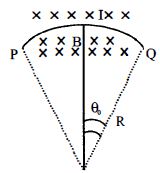
- 7A wire carrying current $I$ is tied between points $P$ and $Q$ and is in the shape of a circular arc of radius $R$ due to a uniform magnetic field $B$ (perpendicular to the plane of the paper, shown by $\times \times \times $) in the vicinity of the wire. If the wire subtends an angle $2\theta_0$ at the centre of the circle (of which it forms an arc) then the tension in the wire isView Solution
- 8A uniform magnetic field acts at right angles to the direction of motion of electrons. As a result, the electron moves in a circular path of radius $2\, cm$. If the speed of the electrons is doubled, then the radius of the circular path will be.....$cm$View Solution
- 9View SolutionA charged particle enters a uniform magnetic field perpendicular to it. The magnetic field
- 10View SolutionThe radius of curvature of the path of the charged particle in a uniform magnetic field is directly proportional to