An arc of a circle of radius $R$ subtends an angle $\frac{\pi }{2}$ at the centre. It carries a current $i$. The magnetic field at the centre will be
Easy


Download our appand get started for free
Experience the future of education. Simply download our apps or reach out to us for more information. Let's shape the future of learning together!No signup needed.*
Similar Questions
- 1At a specific instant emission of radioactive compound is deflected in a magnetic field. The compound can emitView Solution
$(i)$ Electrons $(ii)$ Protons $(iii)$ $H{e^{2 + }}$ $(iv)$ Neutrons
The emission at the instant can be
- 2View SolutionWhich of the following gives the value of magnetic field according to, Biot-Savart’s law’
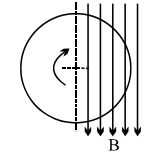
- 3A thin non conducting disc of radius $R$ is rotating clockwise (see figure) with an angular velocity $w$ about its central axis, which is perpendicular to its plane. Both its surfaces carry $+ve$ charges of uniform surface density. Half the disc is in a region of a uniform, unidirectional magnetic field $B$ parallel to the plane of the disc, as shown. Then,View Solution
- 4A galvanometer of $25 \,\Omega$ resistance can read a maximum current of $6\,mA$. It can be used as a voltmeter to measure a maximum of $6\, V$ by connecting a resistance to the galvanometer. Identify the correct choice in the given answersView Solution
- 5A charged particle is moving in a circular orbit of radius $6\, cm$ with a uniform speed of $3 \times 10^6\, m/s$ under the action of a uniform magnetic field $2 \times 10^{-4}\, Wb/m^2$ which is at right angles to the plane of the orbit. The charge to mass ratio of the particle isView Solution
- 6View SolutionIn a cyclotron, a charged particle
- 7An ion beam of specific charge $5 \times 10^7$ $coulomb/kg$ enter a uniform magnetic field of $4 \times 10^{-2}\, tesla$ with a velocity $2 \times 10^5\, m/s$ perpendicularly. The radius of the circular path of ions in meter will beView Solution
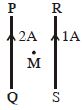
- 8$PQ$ and $RS$ are long parallel conductors separated by certain distance. $M$ is the mid-point between them (see the figure). The net magnetic field at $M$ is $B$ . Now, the current $2\,A$ is switched off. The field at $M$ now becomesView Solution
- 9If $n$ represents the actual number of deflections in a converted galvanometer of resistance $G$ and shunt resistance $S$. Then the total current I when its figure of merit is $K$ will beView Solution
- 10A closely wounded circular coil of radius $5\,cm$ produces a magnetic field of $37.68 \times 10^{-4}\,T$ at its center. The current through the coil is $......A$. [Given, number of turns in the coil is $100$ and $\pi=3.14]$View Solution