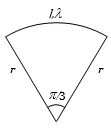
An arc of radius $r$ carries charge. The linear density of charge is $\lambda$ and the arc subtends a angle $\frac{\pi }{3}$ at the centre. What is electric potential at the centre
Medium


Download our appand get started for free
Experience the future of education. Simply download our apps or reach out to us for more information. Let's shape the future of learning together!No signup needed.*
Similar Questions
- 1If the electric potential at any point $(x, y, z) \,m$ in space is given by $V =3 x ^{2}$ volt. The electric field at the point $(1,0,3) \,m$ will be ............View Solution
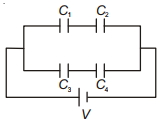
- 2Find the charge on capacitor $C_3$View Solution
Given, that $C_1=C_2=C$ and $C_3=C_4=3 C$.
- 3View SolutionA parallel plate air capacitor is charged and then isolated. When a dielectric material is inserted between the plates of the capacitor, then which of the following does not change
- 4A $10\,pF$ capacitor is connected to a $50 \,V$ battery. How much electrostatic energy is stored in the capacitorView Solution
- 5Two positively charged particles $X$ and $Y$ are initially far away from each other and at rest. $X$ begins to move towards $Y$ with some initial velocity. The total momentum and energy of the system are $p$ and $E$.View Solution
- 6If $4 \times {10^{20}}eV$ energy is required to move a charge of $0.25$ coulomb between two points. Then what will be the potential difference between them......$V$View Solution
- 7When air in a capacitor is replaced by a medium of dielectric constant $K$, the capacityView Solution
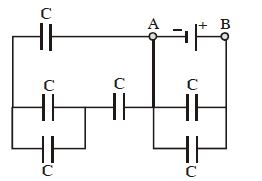
- 8Find equivalent capacitance between $A$ and $B$View Solution
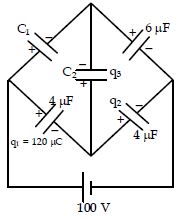
- 9In the circuit shown, $q_2$ and $q_3$ are respectively (Initially all capacitors are uncharged)View Solution
- 10An electron of mass $m$ and charge $e$ is accelerated from rest through a potential difference $V$ in vacuum. The final speed of the electron will beView Solution