Two positively charged particles $X$ and $Y$ are initially far away from each other and at rest. $X$ begins to move towards $Y$ with some initial velocity. The total momentum and energy of the system are $p$ and $E$.
Diffcult
Download our app for free and get started
We know that electrostatic force is conservative. So the mechanical energy remains conserve when the external force is acting. Therefore, momentum is not conserve.
So $(B)$ is the right option.
So $(B)$ is the right option.

Download our appand get started for free
Experience the future of education. Simply download our apps or reach out to us for more information. Let's shape the future of learning together!No signup needed.*
Similar Questions
- 1Three concentric metal shells $A, B$ and $C$ of respective radii $a, b$ and $c (a < b < c)$ have surface charge densities $+\sigma,-\sigma$ and $+\sigma$ respectively. The potential of shell $B$ isView Solution
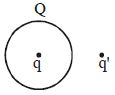
- 2A thin metallic spherical shell contains a charge $Q$ on it. A point charge $+q$ is placed at the centre of the shell and another charge $q'$ is placed outside it as shown in fig. All the three charges are positive. The force on the central charge due to the shell is :-View Solution
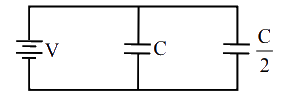
- 3Two condensers, one of capacity $C$ and other of capacity $C/2$ are connected to a $V-$ volt battery, as shown in the figure. The work done in charging fully both the condensers isView Solution
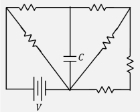
- 4View SolutionConsider the circuit shown in the figure below. All the resistors are identical. The charge stored in the capacitor, once it is fully charged is
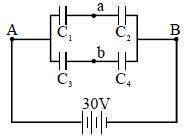
- 5Four capacitors with capacitances $C_1 = 1\,\mu F, C_2 = 1.5\,\mu F, C_3 = 2.5\,\mu F$ and $C_4 = 0.5\,\mu F$ are connected as shown and are connected to a $30\, volt$ source. The potential difference between points $a$ and $b$ is.....$V$View Solution
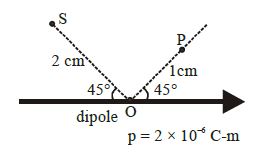
- 6If $OP = 1\,\,cm$ and $OS = 2\,\, cm$, work done by electric field in shifting a point charge $\frac {4\sqrt 2}{27}\,\, μC$ from point $P$ to $S$ in given figure isView Solution
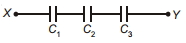
- 7In the circuit below $C_1=20 \,\mu F , C_2=40 \,\mu F$ and $C_3=50 \,\mu F$. If no capacitor can sustain more than $50 \,V$, then maximum potential difference between $X$ and $Y$ is .......... $V$View Solution
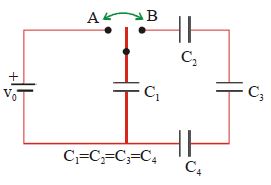
- 8The four identical capacitors in the circuit shown below are initially uncharged. The switch is then thrown first to position $A$, and then to position $B$. After this is done:View Solution
Note: $V_{1,2,3,4}$ are the potential differences across $C_{1,2,3,4}$ and $Q_{1,2,3,4}$ are the final charges stored in $C_{1,2,3,4}$ respectively.
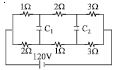
- 9In the circuit shown in figure $C_1 = C_2 = 2$ $\mu F$. Then charge stored inView Solution
- 10A square of side ‘$a$’ has charge $Q$ at its centre and charge ‘$q$’ at one of the corners. The work required to be done in moving the charge ‘$q$’ from the corner to the diagonally opposite corner isView Solution