An army vehicle of mass $1000\, kg$ is moving with a velocity of $10 \,m/s$ and is acted upon by a forward force of $1000\, N$ due to the engine and a retarding force of $500 \,N$ due to friction. ........... $m/s$ will be its velocity after $10\, s$
Medium
Download our app for free and get started
(c)$v = u + \frac{F}{m}t = 10 + \left( {\frac{{1000 - 500}}{{1000}}} \right) \times 10 = 15\,m/s$

Download our appand get started for free
Experience the future of education. Simply download our apps or reach out to us for more information. Let's shape the future of learning together!No signup needed.*
Similar Questions
- 1A block slides down on an inclined surface of inclination $30^o$ with the horizontal. Starting from rest it covers $8\, meter$ in the first two seconds. The coefficient of friction is $(g = 10\, ms^{-2})$View Solution
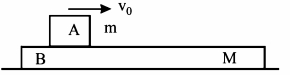
- 2The masses of blocks A and B are $m$ and $M$ respectively. Between $A$ and $B$, there is a constant frictional force $F$ and $B$ can slide on a smooth horizontal surface. A is set in motion with velocity while $B$ is at rest. What is the distance moved by A relative to $B$ before they move with the same velocity?View Solution
- 3A bullet of mass $4\,g$ is fired horizontally with a speed of $300\,m/s$ into $0.8\,kg$ block of wood at rest on a table. If the coefficient of friction between the block and the table is $0.3,$ how far will the block slide approximately?View Solution
- 4A body of mass $5\, kg$ is moving in a circle of radius $1\,m$ with an angular velocity of $2$ radian/sec. The centripetal force is ......... $N$View Solution
- 5One end of string of length $l$ is connected to a particle of mass $'m'$ and the other end is connected to a small peg on a smooth horizontal table. If the particle moves in circle with speed $'v',$ the net force on the particle (directed towards centre) will be ($T$ represents the tension in the string)View Solution
- 6A train is running at $20 \,m / s$ on a railway line with radius of curvature $40,000$ metres. The distance between the two rails is $1.5$ metres. For safe running of train the elevation of outer rail over the inner rail is ......$mm$ $\left( g =10 \,m / s ^2\right)$View Solution
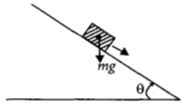
- 7A plank with a box on it at one end is gradually raised about the other end. As the angle of inclination with the horizontal reaches $30^o $, the box starts to slip and slides $4.0\, m $ down the plank in $4.0\, s.$ The coefficients of static and kinetic friction between the box and the plank will be, respectivelyView Solution
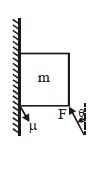
- 8A block of $1\, kg$ is stopped against a wall by applying a force $F$ perpendicular to the wall. If $\mu = 0.2$ then minimum value of $F$ will be ....... $N.$View Solution
- 9A motorcycle is going on an overbridge of radius $R$. The driver maintains a constant speed. As the motorcycle is ascending on the overbridge, the normal force on itView Solution
- 10A block of mass $m$ (initially at rest) is sliding up (in vertical direction) against a rough vertical wall with the help of a force $F$ whose magnitude is constant but direction is changing. $\theta = {\theta _0}t$ where $t$ is time in sec. At $t$ = $0$ , the force is in vertical upward direction and then as time passes its direction is getting along normal, i.e., $\theta = \frac{\pi }{2}$ .The value of $F$ so that the block comes to rest when $\theta = \frac{\pi }{2}$ , isView Solution