MCQ
An artificial satellite revolves around a planet for which gravitational force $(F)$ varies with distance $r$ from its centre as $F \propto r^2$. If $v_0$ its orbital speed, then
  • A
    $v_0 \propto r^{-1 / 2}$
  • $v_0 \propto r^{3 / 2}$
  • C
    $v_0 \propto r^{-3 / 2}$
  • D
    $v_0 \propto r$

Answer

Correct option: B.
$v_0 \propto r^{3 / 2}$
b
(b)

Gravitational force $(F)$ provides the necessary centripetal force to keep the satellite in orbit,

$\Rightarrow \frac{m v_0^2}{r} \propto F$

$\frac{m v_0^2}{r} \propto r^2$

$v_0 \rightarrow \text { Orbital speed }$

$r \rightarrow \text { Radius of orbit }$

$\Rightarrow v_0 \propto r^{3 / 2}$

Need a full question paper?

Generate a complete, print-ready paper with questions like this in minutes — across 16+ boards, with answer keys.

Start Generating Free

Similar questions

At sun rise or sunset, the sun looks more red than at mid-day because
If $F_o$ and $F_e$ are the focal length of the objective and eye-piece respectively of a telescope, then its magnifying power will be
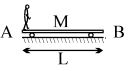
The figure shows a man of mass $m$ standing at the end $A$ of a trolley of mass $M$ placed at rest on a smooth horizontal surface. The man starts moving towards the end $B$ with a velocity $u_{rel}$ with respect to the trolley. The length of the trolley is $L$. When the man reaches the end $B$, the distance moved by the trolley with respect to ground is
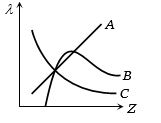
The variation of wavelength $\lambda $ of the ${K_\alpha }$ line with atomic number $Z$ of the target is shown by the following curve of
The temperature coefficient of resistance for a wire is $0.00125\,^oC$. At  $300\,K$ its resistance is $1\, ohm$. The temperature at which the resistance becomes $2\, ohm$ is .......... $K$
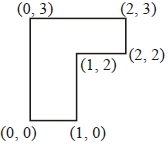
The coordinates of centre of mass of a uniform flag shaped lamina (thin flat plate) of mass $4\;kg$. (The coordinates of the same are shown in figure) are
Two wires $A$ and $B$ of same material have radii in the ratio $2: 1$ and lengths in the ratio $4: 1$. The ratio of the normal forces required to produce the same change in the lengths of these two wires is .......
A $2\, MeV$ proton is moving perpendicular to a uniform magnetic field of $2.5\, tesla$. The force on the proton is
Two wires are made of the same material and have the same volume. However wire $1$ has crosssectional area $A$ and wire $2$ has cross-section area $3A$. If the length of wire $1$ increases by $\Delta x$ on applying force $F$, how much force is needed to stretch wire $2$ by the same amount?
The heat radiated per unit area in $1\,hour$ by a furnace whose temperature is $3000\,K$ is $( \sigma  = 5. 7 \times 10^{-8}\,W\,m^{-2}\,K^{-4})$