Question
An astronomical telescope is an optical instrument which is used for observing distinct images of heavenly bodies libe stars, planets etc. It consists of two lenses. In normal adjustment of telescope, the final image is formed at infinity. Magnifying power of an astronomical telescope in normal adjustment is defined as the ratio of the angle subtended at the eye by the angle subtended at the eye by the final image to the angle subtended at the eye, by the object directly, when the final image and the object both lie at infinite distance from the eye. It is given by, $\text{m}=\frac{\text{f}_0}{\text{f}_\text{g}}.$ To increase magnifying power of an astronomical telescope in normal adjustment, focal length of objective lens should be large and focal length of eye lens should be small.
  1. An astronomical telescope of magnifying power $7$ consists of the two thin lenses $40\ cm$ apart, in normal adjustment. The focal lengths of the lenses are
  1. $5\ cm, 35\ cm$
  2. $7\ cm, 35\ cm$
  3. $17\ cm, 35\ cm$
  4. $5\ cm, 30\ cm$
  1. An astronomical telescope has a magnifying power of $10.$ In normal adjustment, distance between the objective and eye piece is $22\ cm.$ The focal length of objective lens is:
  1. $25\ cm$
  2. $10\ cm$
  3. $15\ cm$
  4. $20\ cm$
  1. In astronomical telescope compare to eye piece, objective lens has:
  1. Negative focal length.
  2. Zero focal length.
  3. Small focal length.
  4. Large focal length.
  1. To see stars, use:
  1. Simple microscope.
  2. Compound microscope.
  3. Endoscope.
  4. Astronomical telescope.
  1. For large magnifying power of astronomical telescope.
  1. $f_0 << f_e$
  2. $f_0 << f_e$
  3. $f_0 << f_e$
  4. None of these.

Answer

  1. $(a) 5\ cm, 35\ cm$
$\text{m}=\frac{\text{f}_0}{\text{f}_\text{e}}=7$
$\text{f}_0=7\text{f}_e$
In normal adjustment, distance between the lenses,
$\text{f}_0+\text{f}_\text{e}=40$
$7\text{f}_0+\text{f}_\text{e}=40$
$\Rightarrow\text{f}_\text{e}=\frac{40}{8}=5\ \text{cm}$
$\text{f}_0=7\text{f}_\text{e}=7\times5$
$=35\ \text{cm}$
  1. $(d) 20\ cm$
$\text{m}=-10;\text{L}=22\ \text{cm}$
As, $\text{m}=\frac{-\text{f}_0}{\text{f}_e}$
$\Rightarrow-10=-\frac{\text{f}_0}{\text{f}_\text{e}}$
$\text{f}_0=10\text{f}_\text{e}$
As, $\text{L}=\text{f}_0+\text{f}_\text{e}$
$22=10\text{f}_\text{e}+\text{f}_e=11\text{f}_\text{e}$
or $\text{f}_\text{e}=\frac{22}{11}=2\ \text{cm}$
$\text{f}_0=10\text{f}_\text{e}=20\ \text{cm}$
  1. $(d)$ Large focal length.
Objective lens has larger focal length than eye$-$piece.
  1. $(d)$ Astronomical telescope.Astronomial telescope is used to see stars, sun etc.
  1. $(c) f_0 << f_e$

Need a full question paper?

Generate a complete, print-ready paper with questions like this in minutes — across 16+ boards, with answer keys.

Start Generating Free

Similar questions

After a good meal at a party you wash your hands and find that you have forgotten to bring your handkerchief. You shake your hands vigorously to remove the water as much as you can. Why is water removed in this process?

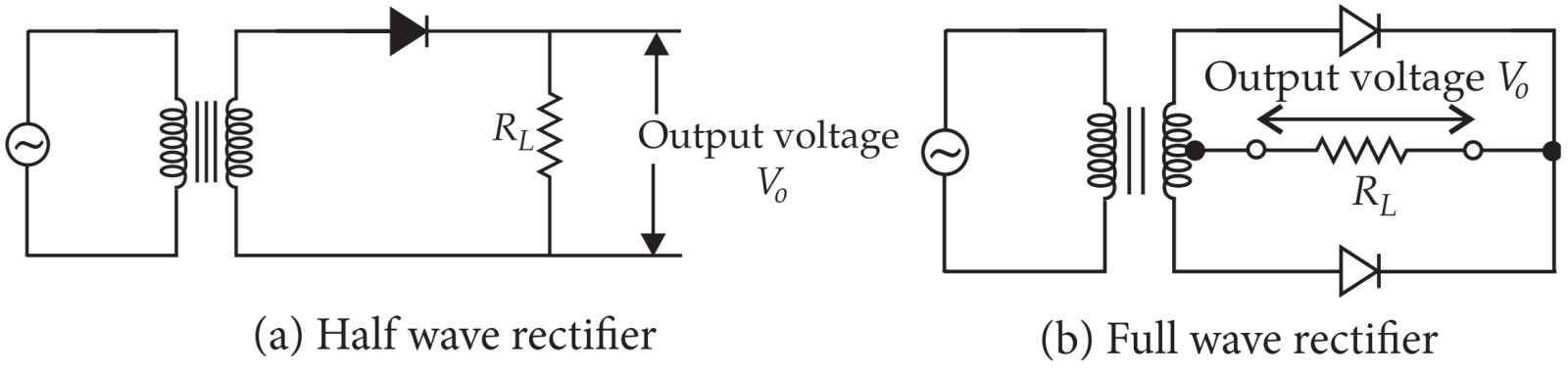
Rectifier is a device which is used for converting alternating current or voltage into direct current or voltage. Its working is based on the fact that the resistance of p-n junction becomes low when forward biased and becomes high when reverse biased. A half-wave rectifier uses only a single diode while a full wave rectifier uses two diodes as shown in figures (a) and (b).
  1. If the rms value of sinusoidal input to a full wave rectifier is $\frac{\text{V}_0}{\sqrt{2}}$ then the rms value of the rectifier's output is:
  1. $\frac{\text{V}_0}{\sqrt{2}}$
  2. $\frac{\text{V}_0^2}{\sqrt{2}}$
  3. $\frac{\text{V}_0^2}{2}$
  4. $\sqrt{2}\text{V}_0^2$
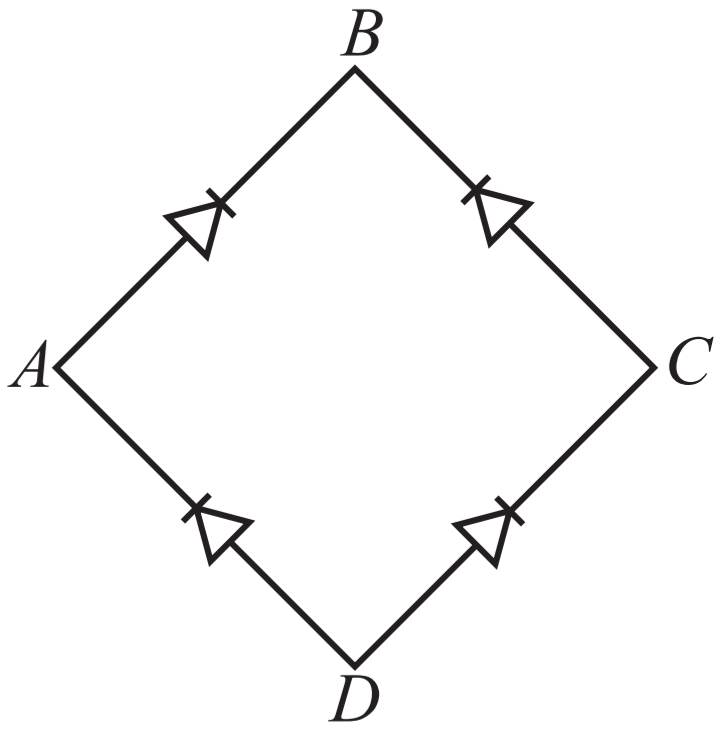
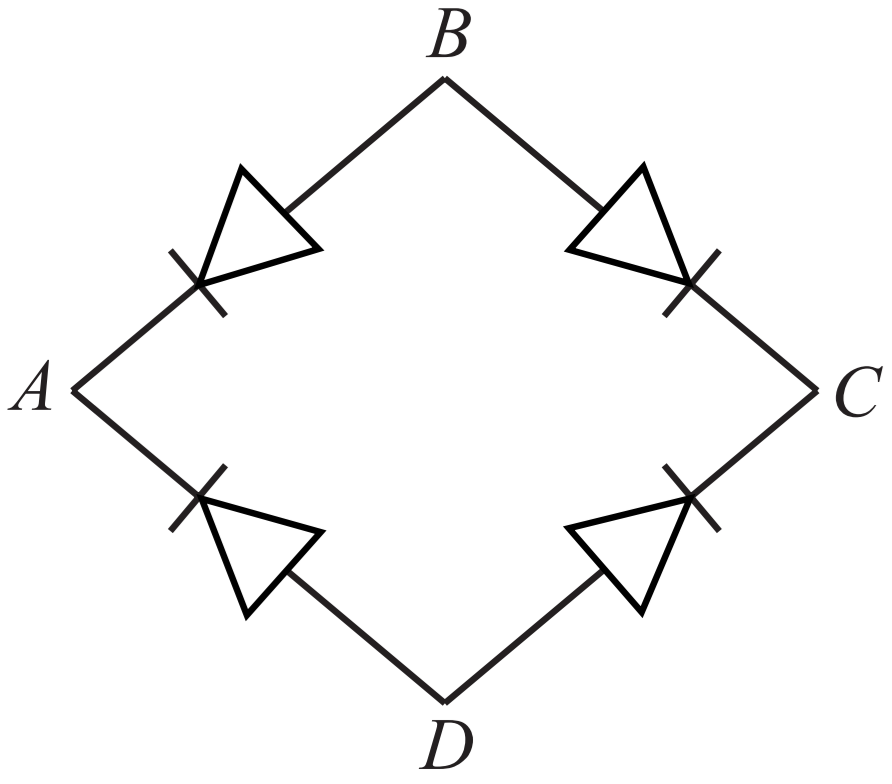
  1. In the diagram, the input ac is across the terminals A and C. The output across B and D is:
  1. Same as the input.
  2. Half wave rectified.
  3. Zero.
  4. Full wave rectified.
  1. A bridge rectifier is shown in figure. Alternating input is given across A and C. If output is taken across BD, then it is:
  1. Zero.
  2. Same as input.
  3. Half wave rectified.
  4. Full wave rectified.
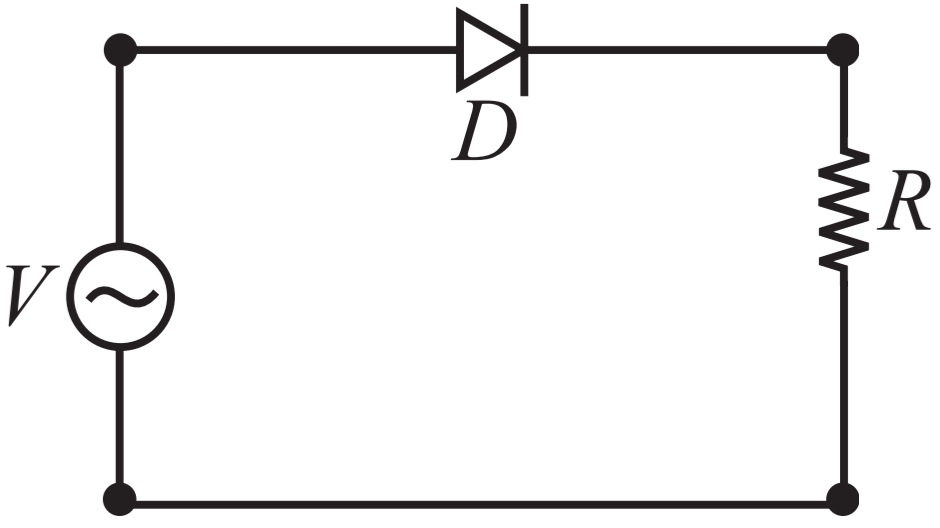
  1. A p-n junction (D) shown in the figure can act as a rectifier. An alternating current source (V) is connected in the circuit. The current (I) in the resistor (R) can be shown by:

  1. With an ac input from 50Hz power line, the ripple frequency is:
  1. 50Hz in the de output of half wave as well as full wave rectifier.
  2. 100Hz in the de output of half wave as well as full wave rectifier.
  3. 50Hz in the de output of half wave and I 00Hz in de output of full wave rectifier.
  4. 100Hz in the de output of half wave and 50Hz in the de output of full wave rectifier.
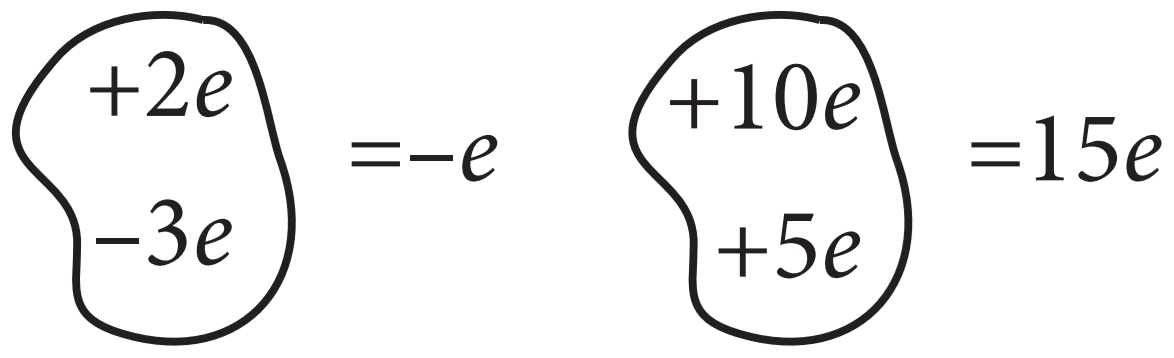
Smallest charge that can exist in nature is the charge of an electron. During friction, it is only the transfer of electrons which makes the body charged. Hence, net charge on any body is an integral multiple of charge of an electron $[1.6 x 10^{-19}C]$ i.e. $q = ± $ ne Where $n = 1, 2, 3, 4,....$
Hence, no body can have a charge represented as $1.1 e, 2. 7e, \frac{3}{5}\text{e,}$ etc.
Recently, it has been discovered that elementary particles such as protons or neutrons are composed of more elemental units called quarks.
  1. Which of the following properties is not satisfied by an electric charge?
  1. Total charge conservation.
  2. Quantization of charge.
  3. Two types of charge.
  4. Circular line of force.
  1. Which one of the following charges is possible?
  1. $2 \times 10^{12}$
  2. $3 \times 10^{12}$
  3. $2 \times 10^{14}$
  4. $3 \times 10^{14}$
  5. $A$ polythene piece rubbed with wool is found to have a negative charge of $3.2 \times 10^{-7} C$. Calculate the number of electrons transferred.
  6. $190.19$ years
  7. $150.12$ years
  8. $198.19$ years
  9. $188.21$ years
  10. If a body gives out $10^9$ electrons every second, how much time is required to get a total charge of $1C$ from it?
  11. $6.25 \times 10^{27}$
  12. $1.16 \times 10^{19}$
  13. $6.25 \times 10^{28}$
  14. $6.25 \times 10^9$
  15. If a charge on a body is $1nC,$ then how many electrons are present on the body?
  16. $5.8 \times 10^{-18}C$
  17. $3.2 \times 10^{-18}C$
  18. $4.5 \times 10^{-19}C$
  19. $8.6 \times 10^{-18}C$
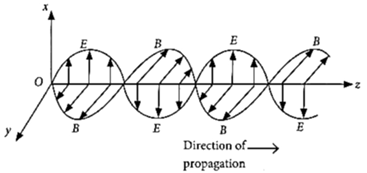
A stationary charge produces only an electrostatic field while a charge in uniform motion produces a magnetic field, that does not change with time. An oscillating charge is an example of accelerating charge. It produces an oscillating magnetic field, which in turn produces an oscillating electric fields and so on. The oscillating electric and magnetic fields regenerate each other as a wave which propagates through space.
Image
$(i).$ Magnetic field in a plane electromagnetic wave is given by $\vec{B}= B _0 \sin ( kx +\omega t ) \hat{j} T$Expression for corresponding electric field will be (Where c is speed of light.)
$(a) \ \vec{E}= B _0 c \sin ( kx +\omega t ) \hat{k} V / m$
$(b) \ \vec{E}=- B _0 c \sin ( kx -\omega t ) \hat{k} V / m$
$(c) \ \vec{E}=- B _0 c \sin ( kx +\omega t ) \hat{k} V / m$
$(d) \ \vec{E}=\frac{B_0}{c} \sin ( kx +\omega t ) \hat{k} V / m$
$(ii)$ The electric field component of a monochromatic radiation is given by $\vec{E}=2 E _0 \hat{i} \cos kz \cos \omega t$. Its magnetic field $\vec{B}$ is then given by
$(a) \ -\frac{2 E_0}{c} \hat{j} \sin kz \sin \omega t$
$(b) \ \frac{2 E_0}{c} \hat{j} \sin kz \sin \omega t$
$(c) \ \frac{2 E_0}{c} \hat{j} \sin kz \cos \omega t$
$(d) \ \frac{2 E_0}{c} \hat{j} \cos kz \cos \omega t$
$(iii)$ A plane em wave of frequency $25 MHz$ travels in a free space along $x -$direction. At a particular point in space and time, $E =(6.3 \hat{j}) V / m$. What is magnetic field at that time?
$(a) \ 0.089 \mu T$
$(b) \ 0.124 \mu T$
$(c) \ 0.021 \mu T$
$(d) \ 0.095 \mu T$
OR
A plane electromagnetic wave travels in free space along $x-$axis. At a particular point in space, the electric field along $y-$axis is $9.3 V m ^{-1}$. The magnetic induction $(B)$ along $z -$axis is
$(a) \ 3.1 \times 10^{-8} T$
$(b) \ 3 \times 10^{-5} T$
$(c) \ 3 \times 10^{-6} T$
$(d) \ 9.3 \times 10^{-6} T$
$(iv)$ A plane electromagnetic wave travelling along the $x-$direction has a wavelength of $3 \ mm$ . The variation in the electric field occurs in the $y-$direction with an amptitude $66 V m ^{-1}$. The equations for the electric and magnetic fields as a function of $x$ and $t$ are respectively
$ \text { a) } E_y =11 \cos 2 \pi \times 10^{11}\left(t-\frac{x}{c}\right), \text { b) } E_y =66 \cos 2 \pi \times 10^{11}\left(t-\frac{x}{c}\right),$
$B_y =11 \times 10^{-7} \cos 2 \pi \times 10^{11}\left(t-\frac{x}{c}\right) B_z =2.2 \times 10^{-7} \cos 2 \pi \times 10^{11}\left(t-\frac{x}{c}\right)$
$\text { c) } E_x =33 \cos \pi \times 10^{11}\left(t-\frac{x}{c}\right), \text { d) } E_y =33 \cos \pi \times 10^{11}\left(t-\frac{x}{c}\right),$
$B_x =11 \times 10^{-7} \cos \pi \times 10^{11}\left(t-\frac{x}{c}\right) B_z =1.1 \times 10^{-7} \cos \pi \times 10^{11}\left(t-\frac{x}{c}\right)$
An electric charge of $17.7 \times 10^{-4}$ Coulomb is distributed uniformly on a large thin sheet of area $200 m^2$. Find the intensity of the electric field in air at a distance of 20 cm from it.
Find the acceleration due to gravity of the moon at a point $1000\ km$ above the moon's surface. The mass of the moon is $7.4 \times 10^{22}kg$ and its radius is $1740\ km.$
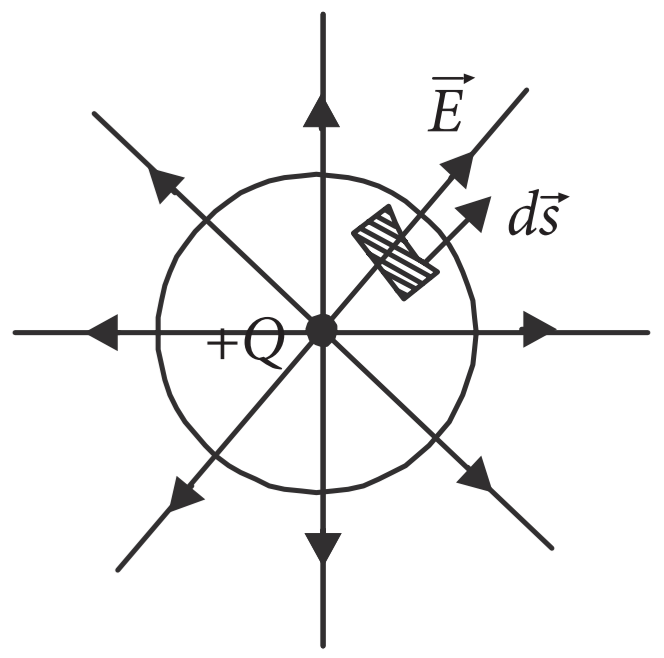
Gauss's law and Coulomb's law, although expressed in different forms, are equivalent ways of describing the relation between charge and electric field in static conditions. Gauss's law is $\epsilon_0\phi=\text{q}_{\text{end},}$ when $\text{q}_{\text{encl}}$ is the net charge inside an imaginary closed surface called Gaussian surface. $\phi=\oint\vec{\text{E}}\cdot\text{d}\vec{\text{A}}$ gives the electric flux through the Gaussian surface. The two equations hold only when the net charge is in vacuum or air.
  1. If there is only one type of charge in the universe, then $(\vec{\text{E}}\rightarrow$ Electric field, $\text{d}\vec{\text{s}}\rightarrow$ Area vector$)$.
  1. $\oint\vec{\text{E}}\cdot\text{d}\vec{\text{s}}\not=0$ on any surface.
  2. $\oint\vec{\text{E}}\cdot\text{d}\vec{\text{s}}$ could not be defined.
  3. $\oint\vec{\text{E}}\cdot\text{d}\vec{\text{s}}=\infty$ if charge is inside.
  4. $\oint\vec{\text{E}}\cdot\text{d}\vec{\text{s}}=0$ if charge is outside, $\oint\vec{\text{E}}\cdot\text{d}\vec{\text{s}}=\frac{\text{q}}{\epsilon_0}$ if charge is inside.
  1. What is the nature of Gaussian surface involved in Gauss law of electrostatic?
  1. Magnetic.
  2. Scalar.
  3. Vector.
  4. Electrical.
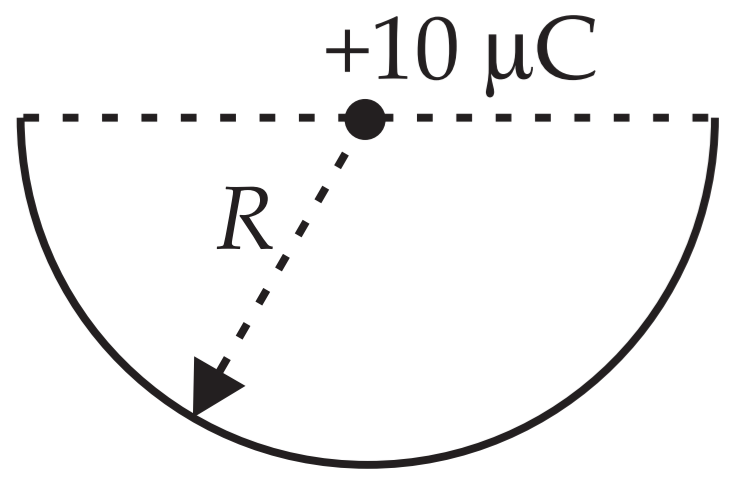
  1. A charge $10\mu\text{C}$ is placed at the centre of a hemisphere of radius $R = 10\ cm$ as shown. The electric flux through the hemisphere $($in $\text{MKS}$ units$)$ is:
  1. $20 \times 10^5$
  2. $10 \times 10^5$
  3. $6 \times 10^5$
  4. $2 \times 10^5$
  1. The electric flux through a closed surface area $S$ enclosing charge $Q$ is $\phi$. If the surface area is doubled, then the flux is:
  1. $2\phi$
  2. $\frac{\phi}{2}$
  3. $\frac{\phi}{4}$
  4. $\phi$
  1. A Gaussian surface encloses a dipole. The electric flux through this surface is:
  1. $\frac{\text{q}}{\epsilon_0}$
  2. $\frac{\text{2q}}{\epsilon_0}$
  3. $\frac{\text{q}}{2\epsilon_0}$
  4. Zero
When a glass capillary tube is dipped at one end in water, water rises in the tube. The gravitational potential energy is thus increased. Is it a violation of conservation of energy?
An electromagnetic wave transports linear momentum as it travels through space. If an electromagnetic wave transfers a total energy $U$ to a surface in time $t ,$ then total linear momentum delivered to the surface is $p =\frac{U}{c}$. When an electromagnetic wave falls on a surface, it exerts pressure on the surface. In $1903,$ the American scientists Nichols and Hull succeeded in measuring radiation pressures of visible light where other had failed, by making a detailed empirical analysis of the ubiquitous gas heating and ballistic effects.

$(i)$ The pressure exerted by an electromagnetic wave of intensity $I \left( W m ^{-2}\right)$ on a non $-$ reflecting surface is $( c $is the velocity of light$)$
$(a) \frac{I}{c}$
$(b) \frac{I}{c^2}$
$(c) Ic ^2$
$(d) IC$

$(ii)$ Light with an energy flux of $18 W / cm ^2$ falls on a non-reflecting surface at normal incidence.
The pressure exerted on the surface is:
$(a) 2 N / m ^2$
$(b) 6 \times 10^{-4} N / m ^2$
$(c) 2 \times 10^{-4} N / m ^2$
$(d) 6 N / m ^2$

$(iii)$ Radiation of intensity $0.5 W m ^{-2}$ are striking a metal plate. The pressure on the plate is
$(a) 0.212 \times 10^{-8} N m ^{-2}$
$(b) 0.132 \times 10^{-8} N m ^{-2}$
$(c) 0.166 \times 10^{-8} N m ^{-2}$
$(d) 0.083 \times 10^{-8} N m ^{-2}$
OR
The radiation pressure of the visible light is of the order of
$(a) 10^{-4} N / m$
$(b) 10^{-6} N / m ^2$
$(c) 10^{-8} N$
$(d) 10^{-2} N m ^2$

$(iv)$ A point source of electromagnetic radiation has an average power output of $1500 W$ .
The maximum value of electric field at a distance of $3 m$ from this source $($in $V m ^{-1})$ is
$(a) 500$
$(b) \frac{500}{3}$
$(c) \frac{250}{3}$
$(d)\ 100$