Question
A stationary charge produces only an electrostatic field while a charge in uniform motion produces a magnetic field, that does not change with time. An oscillating charge is an example of accelerating charge. It produces an oscillating magnetic field, which in turn produces an oscillating electric fields and so on. The oscillating electric and magnetic fields regenerate each other as a wave which propagates through space.
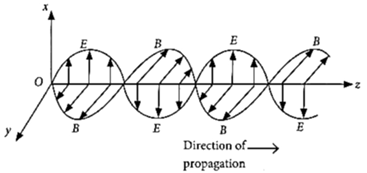
Image
$(i).$ Magnetic field in a plane electromagnetic wave is given by $\vec{B}= B _0 \sin ( kx +\omega t ) \hat{j} T$Expression for corresponding electric field will be (Where c is speed of light.)
$(a) \ \vec{E}= B _0 c \sin ( kx +\omega t ) \hat{k} V / m$
$(b) \ \vec{E}=- B _0 c \sin ( kx -\omega t ) \hat{k} V / m$
$(c) \ \vec{E}=- B _0 c \sin ( kx +\omega t ) \hat{k} V / m$
$(d) \ \vec{E}=\frac{B_0}{c} \sin ( kx +\omega t ) \hat{k} V / m$
$(ii)$ The electric field component of a monochromatic radiation is given by $\vec{E}=2 E _0 \hat{i} \cos kz \cos \omega t$. Its magnetic field $\vec{B}$ is then given by
$(a) \ -\frac{2 E_0}{c} \hat{j} \sin kz \sin \omega t$
$(b) \ \frac{2 E_0}{c} \hat{j} \sin kz \sin \omega t$
$(c) \ \frac{2 E_0}{c} \hat{j} \sin kz \cos \omega t$
$(d) \ \frac{2 E_0}{c} \hat{j} \cos kz \cos \omega t$
$(iii)$ A plane em wave of frequency $25 MHz$ travels in a free space along $x -$direction. At a particular point in space and time, $E =(6.3 \hat{j}) V / m$. What is magnetic field at that time?
$(a) \ 0.089 \mu T$
$(b) \ 0.124 \mu T$
$(c) \ 0.021 \mu T$
$(d) \ 0.095 \mu T$
OR
A plane electromagnetic wave travels in free space along $x-$axis. At a particular point in space, the electric field along $y-$axis is $9.3 V m ^{-1}$. The magnetic induction $(B)$ along $z -$axis is
$(a) \ 3.1 \times 10^{-8} T$
$(b) \ 3 \times 10^{-5} T$
$(c) \ 3 \times 10^{-6} T$
$(d) \ 9.3 \times 10^{-6} T$
$(iv)$ A plane electromagnetic wave travelling along the $x-$direction has a wavelength of $3 \ mm$ . The variation in the electric field occurs in the $y-$direction with an amptitude $66 V m ^{-1}$. The equations for the electric and magnetic fields as a function of $x$ and $t$ are respectively
$ \text { a) } E_y =11 \cos 2 \pi \times 10^{11}\left(t-\frac{x}{c}\right), \text { b) } E_y =66 \cos 2 \pi \times 10^{11}\left(t-\frac{x}{c}\right),$
$B_y =11 \times 10^{-7} \cos 2 \pi \times 10^{11}\left(t-\frac{x}{c}\right) B_z =2.2 \times 10^{-7} \cos 2 \pi \times 10^{11}\left(t-\frac{x}{c}\right)$
$\text { c) } E_x =33 \cos \pi \times 10^{11}\left(t-\frac{x}{c}\right), \text { d) } E_y =33 \cos \pi \times 10^{11}\left(t-\frac{x}{c}\right),$
$B_x =11 \times 10^{-7} \cos \pi \times 10^{11}\left(t-\frac{x}{c}\right) B_z =1.1 \times 10^{-7} \cos \pi \times 10^{11}\left(t-\frac{x}{c}\right)$
Answer

A stationary charge produces only an electrostatic field while a charge in uniform motion produces a magnetic field, that does not change with time. An oscillating charge is an example of accelerating charge. It produces an oscillating magnetic field, which in turn produces an oscillating electric fields and so on. The oscillating electric and magnetic fields regenerate each other as a wave which propagates through space.
Image
$(i) \ (a) \ \vec{E}= B _0 c \sin ( kx +\omega t ) \hat{k} V / m$
Explanation: Given : $\vec{B}= B _0 \sin ( kx +\omega t ) \hat{j} T$
The relation between electric and magnetic field is, $c =\frac{E}{B}$ or $E = cB$
The electric field component is perpendicular to the direction of propagation and the direction of magnetic field. Therefore, the electric field component along z-axis is obtained as $\vec{E}= cB _0 \sin ( kx +\omega t ) \hat{k} V / m$
$(ii) \ (b) \ \frac{2 E_0}{c} \hat{j} \sin kz \sin \omega t$
Explanation: $\frac{d E}{d z}=-\frac{d B}{d t}$
$\frac{d E}{d z}=-2 E _0 k \sin kz \cos \omega t =-\frac{d B}{d t}$
$dB =+2 E _0 k \sin kz \cos \omega tdt$
$B =+2 E _0 k \sin kz \int \cos \omega tdt =+2 E _0 \frac{k}{\omega} \sin kz \sin \omega t$
$\frac{E_0}{B_0}=\frac{\omega}{k}=c$
$B =\frac{2 E_0}{c} \sin kz \sin \omega t \therefore \vec{B}=\frac{2 E_0}{c} \sin kz \sin \omega t \hat{j}$
$E$ is along $y-$direction and the wave propagates along $x-$axis.
$\therefore B$ should be in a direction perpendicular to both $x$-and $y-$axis.
$(iii) \ (c) \ 0.021 \mu T$
Explanation: Here, $E =6.3 \hat{j} ; c =3 \times 10^8 m / s$
The magnitude of $B$ is
$B_{Z}=\frac{E}{c}=\frac{6.3}{3 \times 10^8}=2.1 \times 10^{-8} T=0.021 \mu T$
$OR$
$(a) 3.1 \times 10^{-8} T$
Explanation: At a particular point, $E =9.3 V m ^{-1}$
$\therefore$ Magnetic field at the same point $=\frac{9.3}{3 \times 10^8}$
$=3.1 \times 10^{-8} T$
$(iv) \ (b) \ E_y=66 \cos 2 \pi \times 10^{11}\left(t-\frac{x}{c}\right), B_z=2.2 \times 10^{-7} \cos 2 \pi \times 10^{11}\left(t-\frac{x}{c}\right)$
Explanation: Here : $E _0=66 Vm ^{-1}, E _y=66 \cos \omega\left(t-\frac{x}{c}\right)$,
$\lambda=3 mm=3 \times 10^{-3} m, k=\frac{2 \pi}{\lambda}$
$\frac{\omega}{k}=c \Rightarrow \omega=ck=3 \times 10^8 \times \frac{2 \pi}{3 \times 10^{-3}}$
$\text { or } \omega=2 \pi \times 10^{11}$
$\therefore E _{ y }=66 \cos 2 \pi \times 10^{11}\left(t-\frac{x}{c}\right)$
$B _{ z }=\frac{E_y}{c}=\left(\frac{66}{3 \times 10^8}\right) \cos 2 \pi \times 10^{11}\left(t-\frac{x}{c}\right)$
$=2.2 \times 10^{-7} \cos 2 \pi \times 10^{11}\left(t-\frac{x}{c}\right)$

Need a full question paper?

Generate a complete, print-ready paper with questions like this in minutes — across 16+ boards, with answer keys.

Start Generating Free

Similar questions


The field of a hollow wire with constant current is homageneous.
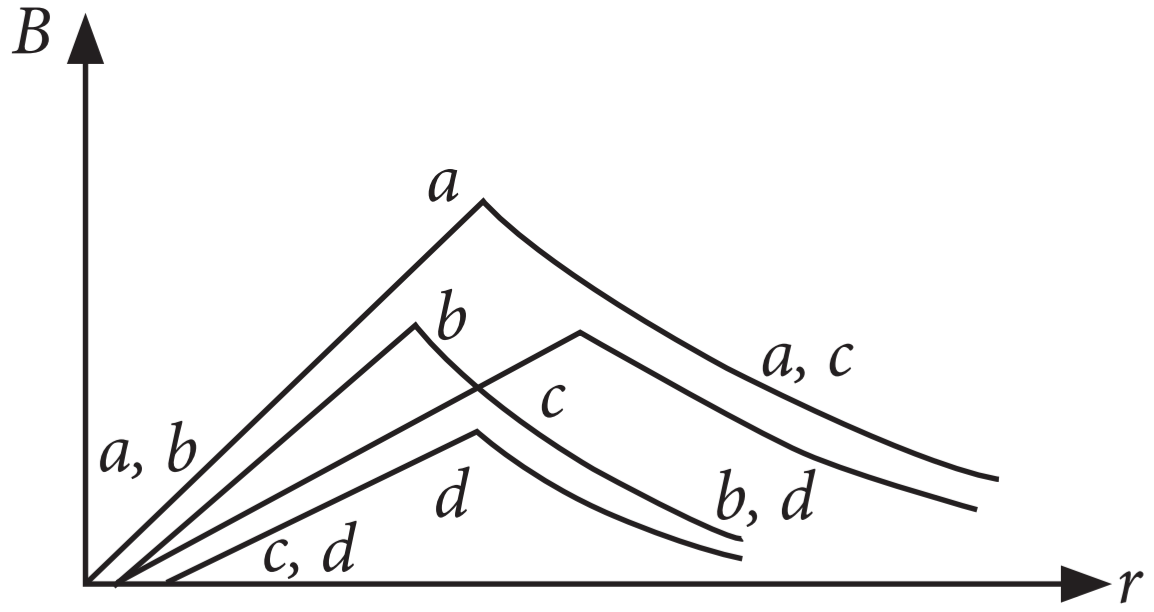
Curves in the graph shown give, as functions of radius distance r, the magnitude B of the magnetic field inside and outside four long wires a, b, c and d, carrying currents that are uniformly distributed across the cross sections of the wires. Overlapping portions of the plots are indicated by double labels.
  1. Which wire has the greatest magnitude of the magnetic field on the surface?
  1. a
  2. b
  3. c
  4. d
  1. The current density in a wire a is:
  1. Greater than in wire c.
  2. Less than in wire c.
  3. Equal to that in wire c.
  4. Not comparable to that of in wire c due to lack of information.
  1. Which wire has the greatest radius?
  1. a
  2. b
  3. c
  4. d
  1. A direct current I flows along the length of an infinitely long straight thin walled pipe, then the magnetic field is:
  1. Uniform throughout the pipe but not zero.
  2. Zero only along the axis of the pipe.
  3. Zero at any point inside the pipe.
  4. Maximum at the centre and minimum at the edges.
  1. In a coaxial, straight cable, the central conductor and the outer conductor carry equal currents in opposite direction. The magnetic field is zero.
  1. Outside the cable.
  2. Inside the inner conductor.
  3. Inside the outer conductor.
  4. In between the two conductor.
A heavy nucleus breaks into comparatively lighter nuclei, which are more stable compared to the original heavy nucleus. When a heavy nucleus like uranium is bombarded by slow moving neutrons, it splits into two parts, releasing large amount of energy. The typical fission reaction of $_{92}\text{U}^{235}$.
$_{92}\text{U}^{235}+\ _0\text{n}^1\rightarrow\ _{56}\text{Ba}^{141}+\ _{36}\text{kr}^{92}+\ 3_0\text{n}^1+\ 200\text{ MeV}$
The fission of $_{92}\text{U}^{235}$ approximately released $200 MeV$ of energy.
  1. If $200 MeV$ energy is released in the fission of a single nucleus of $_{92}^{235}\text{U}$, the fissions which are required to produce a power of $1kW$ is.
  1. $3.125 \times 10^{13}$
  2. $1.52 \times 10^6$
  3. $3.125 \times 10^{12}$
  4. $3.125 \times 10^{14}$
  1. The release in energy in nuclear fission is consistent with the fact that uranium has
  1. More mass per nucleon than either of the two fragments.
  2. More mass per nucleon as the two fragment.
  3. Exactly the same mass per nucleon as the two fragments.
  4. Less mass per nucleon than either of two fragments.
  1. When $_{92}\text{U}^{235}$ undergoes fission, about $0.1\%$ of the original mass is converted into energy. The energy released when $1\ kg$ of $_{92}\text{U}^{235}$ undergoes fission is.
  1. $9 \times 10^{11}J$
  2. $9 \times 10^{13}J$
  3. $9 \times 10^{15}J$
  4. $9 \times 10^{18}J$
  1. A nuclear fission is said to be critical when multiplication factor or $K$.
  1. $K = 1$
  2. $K > 1$
  3. $K < 1$
  4. $K = 0$
  1. Einstein's mass-energy conversion relation $E = mc^2$ is illustrated by.
  1. Nuclear fission
  2. $\beta-$ decay
  3. Rocket propulsion
  4. Steam engine
Derive lens Maker formula $\frac{1}{f}=\left(n_{21}-1\right)\left(\frac{1}{R_1}-\frac{1}{R_2}\right)$. Here are the general meanings of the symbols used in the formula. Draw necessary diagram.
A tungsten cathode and a thoriated-tungsten cathode have the same geometric dimensions and are operated at the same temperature. The thoriated-tungsten cathode gives 5000 times more current than the other cathode. Find the operating temperature. Take relevant data from the previous problem.
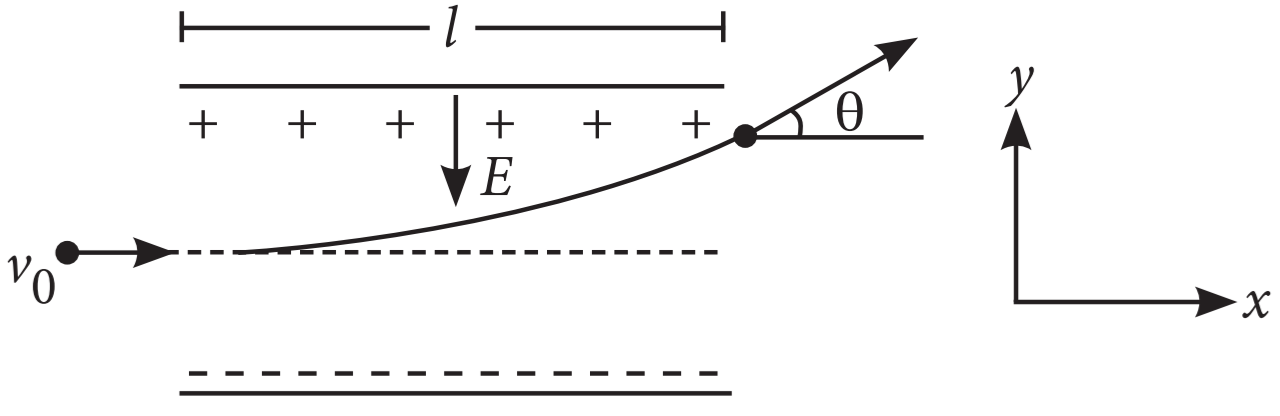
When a charged particle is placed in an electric field, it experiences an electrical force. If this is the only force on the particle, it must be the net force. The net force will cause the particle to accelerate according to Newton's second law. So $\vec{\text{F}}_\text{e}=\text{q}\vec{\text{E}}=\text{m}\vec{\text{a}}$
If $\vec{\text{E}}$ is uniform, then $\vec{\text{a}}$ is constant and $\vec{\text{a}}=\text{q}\vec{\text{E}}\text{/ m.}$ If the particle has a positive charge, its acceleration is in the direction of the field. If the particle has a negative charge, its acceleration is in the direction opposite to the electric field. Since the acceleration is constant, the kinematic equations can be used.
  1. An electron of mass $m,$ charge e falls through a distance h metre in a uniform electric field $E$. Then time of fall,
  1. $\text{t}=\sqrt{\frac{\text{2hm}}{\text{eE}}}$
  2. $\text{t}=\frac{\text{2hm}}{\text{eE}}$
  3. $\text{t}=\sqrt{\frac{\text{2eE}}{\text{hm}}}$
  4. $\text{t}=\frac{\text{2eE}}{\text{hm}}$
  1. An electron moving with a constant velocity $v$ along $X-$ axis enters a uniform electric field applied along $Y-$ axis. Then the electron moves:
  1. With uniform acceleration along $Y-$ axis
  2. Without any acceleration along $Y-$ axis
  3. In a trajectory represented as $y = ax^2$
  4. In a trajectory represented as $y = ax$
  1. Two equal and opposite charges of masses $m_1$ and $m_2$ are accelerated in an uniform electric field through the same distance. What is the ratio of their accelerations if their ratio of masses is $\frac{\text{m}_1}{\text{m}_2}=0.5?$
  1. $\frac{\text{a}_1}{\text{a}_2}=2$
  2. $\frac{\text{a}_1}{\text{a}_2}=0.5$
  3. $\frac{\text{a}_1}{\text{a}_2}=3$
  4. $\frac{\text{a}_1}{\text{a}_2}=1$
  1. A particle of mass $m$ carrying charge $q$ is kept at rest in a uniform electric field $E$ and then released. The kinetic energy gained by the particle, when it moves through a distance $y$ is:
  1. $\frac{1}{2}\text{qEy}^2$
  2. $qEy$
  3. $qEy^2$
  4. $qE^2y$
  1. $A$ charged particle is free to move in an electric field. It will travel:
  1. Always along a line of force.
  2. Along a line of force, if its initial velocity is zero.
  3. Along a line of force, if it has some initial velocity in the direction of an acute angle with the line of force.
  4. None of these.
Calculate the force with which you attract the earth.
Distance between two successive bright or dark fringes is called fringe width.
$\beta=\text{Y}_\text{n+1}-\text{Y}_\text{n}=\frac{(\text{n}+1)\lambda\text{D}}{\text{d}}-\frac{\text{n}\lambda\text{D}}{\text{d}}=\frac{\lambda\text{D}}{\text{d}}$
Fringe width is independent of the order of the maxima. If whole apparatus is immersed in liquid of refractive index $\mu$ then $\beta=\frac{\lambda\text{D}}{\mu\text{d}} \ ($fringe width decreases$)$. Angular fringe width $(\theta)$ is the angular separation between two consecutive maxima or minima
$\theta=\frac{\beta}{\text{D}}=\frac{\lambda}{\text{d}}$
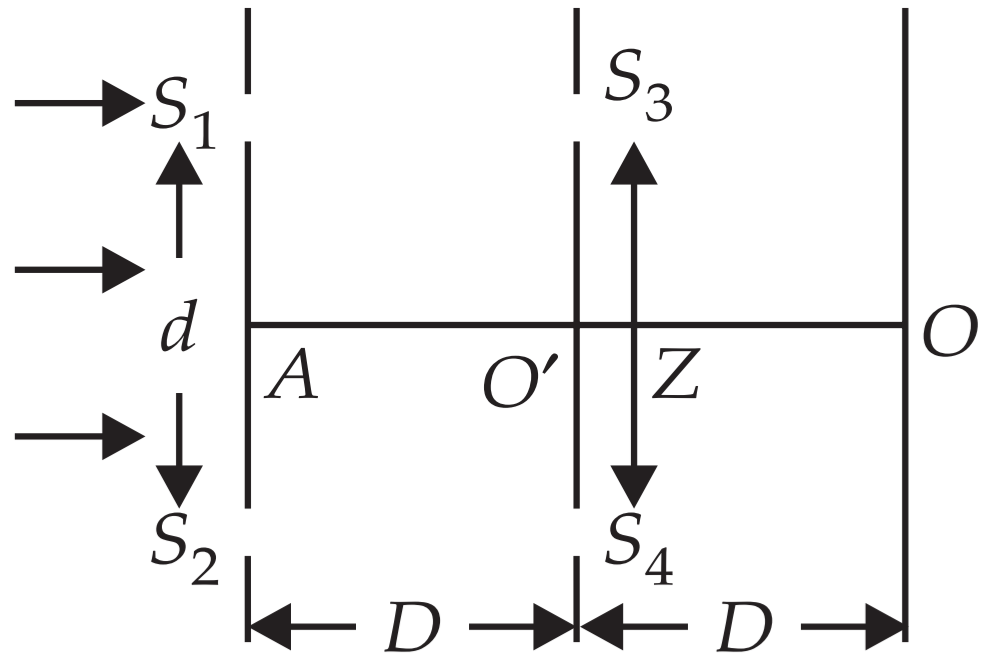
ln the arrangement shown in figure, slit $S_3$ and $S_4 $ are having a variable separation $Z$. Point $O$ on the screen is at the common perpendicular bisector of $S_1,S_2$ and $S_3,S_4.$
  1. The maximum number of possible interference maxima for slit separation equal to twice the wavelength in Young's double $-$ slit experiment, is:
  1. Does not move at all.
  2. Gets displaced from its earlier position.
  3. Becomes coloured.
  4. Disappears.
  5. ln a two slit experiment with white light, a white fringe is observed on a screen kept behind the slits. When the screen is moved away by $0.05m,$ this white fringe.
  6. Remain unaltered.
  7. Become wider.
  8. Become narrower.
  9. Disappear.
  10. When the complete Young's double slit experiment is immersed in water, the fringes.
  11. Unchanged
  12. Halved
  13. Doubled
  14. Quadrupled
  15. ln Young's double slit experiment, if the separation between the slits is halved and the distance between the slits and the screen is doubled, then the fringe width compared to the unchanged one will be.
  16. Wider
  17. Brighter
  18. Narrower
  19. Darker
  20. ln Young's double $- $ slit experiment if yellow light is replaced by blue light, the interference fringes become.
  21. Infinite
  22. Five
  23. Three
  24. Zero
A metal rod is placed along the axis of a solenoid carrying a high-freqμency alternating current. It is found that the rod gets heated. Explain why the rod gets heated.
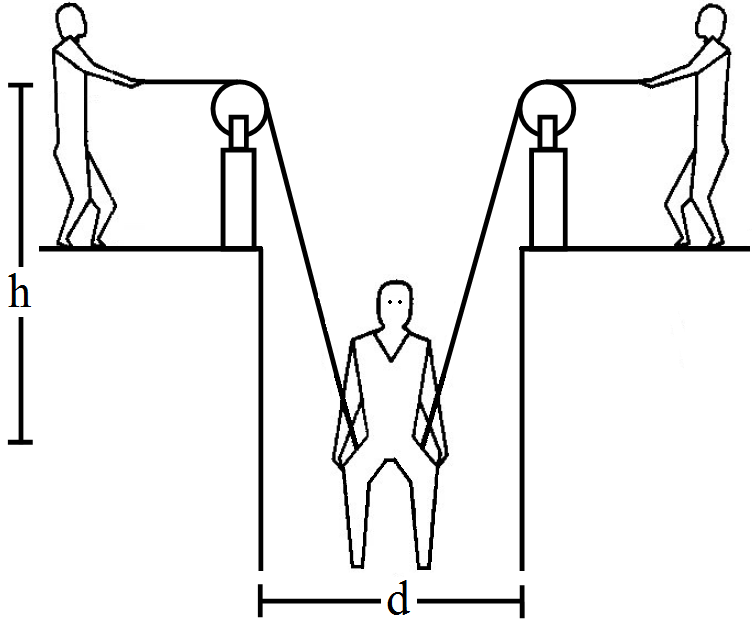
A man has fallen into a ditch of width d and two of his friends are slowly pulling him out using a light rope and two fixed pulleys as shown in figure. Show that the force (assumed equal for both the friends) exerted by each friend on the road increases as the man moves up. Find the force when the man is at a depth h.
A person goes to bed at sharp 10:00 pm every day. Is it an example of periodic motion? If yes, what is the time period? If no, why?