An electric bulb of $100\, watt$ is connected to a supply of electricity of $220\, V$. Resistance of the filament is ............. $\Omega$
Easy


Download our appand get started for free
Experience the future of education. Simply download our apps or reach out to us for more information. Let's shape the future of learning together!No signup needed.*
Similar Questions
- 1A wire of length ' $r$ ' and resistance $100 \Omega$ is divided into $10$ equal parts. The first $5$ parts are connected in series while the next $5$ parts are connected in parallel. The two combinations are again connected in series. The resistance of this final combination is:View Solution
- 2The number of electrons flowing per second in the filament of a $110 \mathrm{~W}$ bulb operating at $220 \mathrm{~V}$ is : (Given $\mathrm{e}=1.6 \times 10^{-19} \mathrm{C}$ )View Solution
- 3View SolutionIf the length of potentiometer wire is increased, then the length of the previously obtained balance point will
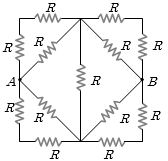
- 4Thirteen resistances each of resistance $R\, ohm$ are connected in the circuit as shown in the figure below. The effective resistance between $A$ and $B$ isView Solution
- 5The two bulbs as in the above question are connected in series to a $200\, volt$ line. ThenView Solution
- 6The resistances of a wire at temperatures $t\,^oC$ and $0\,^oC$ are related byView Solution
- 7View SolutionIf a high power heater is connected to electric mains, then the bulbs in the house become dim, because there is a
- 8Two resistances ${R_1}$ and ${R_2}$ are made of different materials. The temperature coefficient of the material of ${R_1}$ is $\alpha $ and of the material of ${R_2}$ is $ - \beta $. The resistance of the series combination of ${R_1}$ and ${R_2}$ will not change with temperature, if ${R_1}/{R_2}$ equalsView Solution
- 9Water boils in an electric kettle in $20$ minutes after being switched on. Using the same main supply, the length of the heating element should be. . . . . . .to . . . . . .. times of its initial length if the water is to be boiled in $15$ minutes.View Solution
- 10When $5\ V$ potential difference is applied across a wire of length $0.1\ m$, the drift speed of electrons is $2.5 \times 10^{-4}$ $ms^{-1}$ . If the electron density in the wire is $8 \times 10^{28}$ $m^{-3}$ the resistivity of the material is close toView Solution