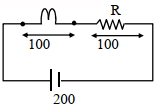
An electric bulb of $500 \,watt$ at $100\, volt$ is used in a circuit having a $200\, {V}$ supply. Calculate the resistance ${R}$ to be connected in series with the bulb so that the power delivered by the bulb is $500\, {W}$. (in $\Omega$)
JEE MAIN 2021, Medium


Download our appand get started for free
Experience the future of education. Simply download our apps or reach out to us for more information. Let's shape the future of learning together!No signup needed.*
Similar Questions
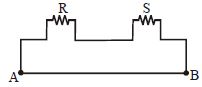
- 1In a meter bridge, the null point is found at a distance of $25\, cm$ from $A$ . If now a resistance of $10\,\Omega $ is connected in parallel with $S$, the null point occurs at mid point of $AB$. The value of $R$ is .............. $\Omega$View Solution
- 2Two resistances of $400\,\Omega $ and $800\,\Omega $ are connected in series with a $6\,volt $ battery of negligible internal resistance. A voltmeter of resistance $10,000\,\Omega $ is used to measure the potential difference across $400\,\Omega $ . The error in the measurement of potential difference (in volt) approximately isView Solution
- 3Four identical cells each having an electromotive force $(e.m.f.)$ of $12\,V$, are connected in parallel. The resultant electromotive force $(e.m.f.)$ of the combination is .............. $V$View Solution
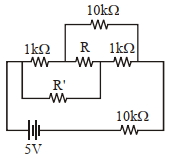
- 4When the resistance $R$ (indicated in the figure below) is changed from $1 \,k \Omega$. to $10 \,k \Omega$, the current flowing through the resistance $R'$ does not change. What is the value of the resistor $R'?$View Solution
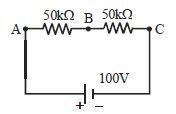
- 5In the adjacent shown circuit, a voltmeter of internal resistance $R$, when connected across $B$ and $C$ reads $\frac{{100}}{3}\,V$. Neglecting the internal resistance of the battery, the value of $R$ is ................. $k \Omega$View Solution
- 6When three identical bulbs of $60 \;W, 200\;V$ rating are connected in series to a $200 \;V$ supply, the power drawn by them will be ....... $Watt$View Solution
- 7A capacitor is connected to a cell of $emf$ $E$ having some internal resistance $r$. The potential difference across theView Solution
- 8The resistance of a wire is$10\,\Omega $. Its length is increased by $10\%$ by stretching. The new resistance will now be .......... $\Omega$View Solution
- 9In a potentiometer circuit there is a cell of $e.m.f.$ $2\, volt$, a resistance of $5\, ohm$ and a wire of uniform thickness of length $1000\, cm$ and resistance $15\, ohm$. The potential gradient in the wire isView Solution
- 10Two resistors of resistance $R_1$ and $R_2$ having $R_1 > R_2$ are connected in parallel. For equivalent resistance $R$, the correct statements isView Solution