In a potentiometer circuit there is a cell of $e.m.f.$ $2\, volt$, a resistance of $5\, ohm$ and a wire of uniform thickness of length $1000\, cm$ and resistance $15\, ohm$. The potential gradient in the wire is
Medium


Download our appand get started for free
Experience the future of education. Simply download our apps or reach out to us for more information. Let's shape the future of learning together!No signup needed.*
Similar Questions
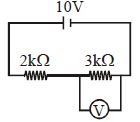
- 1In the circuit shown in figure, the resistance of voltmeter is $6\, k\Omega $. The voltmeter reading will be ................. $\mathrm{V}$View Solution
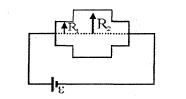
- 2A cylindrical resistance is connected across battery $\varepsilon $ . Cylinder has uniform free electron density, mid part of cylinder has larger radius as shown in figure. Then $V_d$ (drift velocity) $V/S$ (distance across the length of the resistance)View Solution
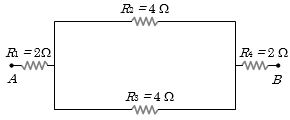
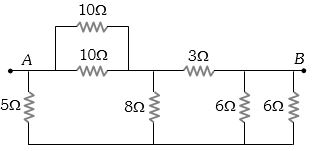
- 3In the given figure, the equivalent resistance between the points $A$ and $B$ is ............ $\Omega$View Solution
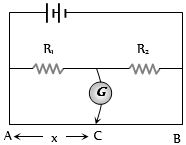
- 4In the shown arrangement of the experiment of the meter bridge if $AC$ corresponding to null deflection of galvanometer is $x$, what would be its value if the radius of the wire $AB$ is doubledView Solution
- 5$50\,\Omega $ and $100\,\Omega $ resistors are connected in series. This connection is connected with a battery of $2.4\, volts$. When a voltmeter of $100\,\Omega $ resistance is connected across $100\,\Omega $ resistor, then the reading of the voltmeter will be ............. $V$View Solution
- 6A carbon resistor has colour strips as violet, yellow brown and golden. The resistance is .............. $\Omega$View Solution
- 7Seven resistances are connected as shown in the figure. The equivalent resistance between $A$ and $B$ is ............... $\Omega$View Solution
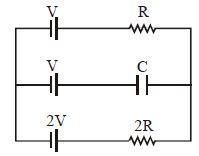
- 8View SolutionIn the given circuit, with steady current, the potential drop across the capacitor must be
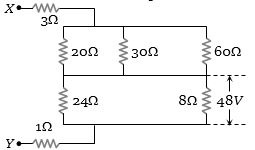
- 9The potential difference across $8\, ohm$ resistance is $48\, volt$ as shown in the figure. The value of potential difference across $X$ and $Y$ points will be ............. $volt$View Solution
- 10A source of $e.m.f.$ $E = 15\,V$ and having negligible internal resistance is connected to a variable resistance so that the current in the circuit increases with time as $i = 1.2 t + 3$. Then, the total charge that will flow in first five second will be ............... $C$View Solution