An electric dipole has the magnitude of its charge as $q$ and its dipole moment is $p$. It is placed in a uniform electric field $E$. If its dipole moment is along the direction of the field, the force on it and its potential energy are respectively
AIPMT 2004, Easy


Download our appand get started for free
Experience the future of education. Simply download our apps or reach out to us for more information. Let's shape the future of learning together!No signup needed.*
Similar Questions
- 1If $Q$ is the charge on the plates of a capacitor of capacitance $C, V$ the potential difference between the plates, $A$ the area of each plate and $d $ the distance between the plates, the force of attraction between the plates isView Solution
- 2Two insulated metallic spheres of $3\,\mu F$ and $5\,\mu F$ capacitances are charged to $300\, V$ and $500\, V$ respectively. The energy loss, when they are connected by a wire isView Solution
- 3A particle of mass $m$ and carrying charge $-q_1$ is moving around a charge $+q_2$ along a circular path of radius r. Find period of revolution of the charge $-q_1$View Solution
- 4Concentric metallic hollow spheres of radii $R$ and $4 R$ hold charges $Q _{1}$ and $Q _{2}$ respectively. Given that surface charge densities of the concentric spheres are equal, the potential difference $V ( R )- V (4 R )$ isView Solution
- 5Two small equal point charges of magnitude $q$ are suspended from a common point on the ceiling by insulating mass less strings of equal lengths. They come to equilibrium with each string making angle $\theta $ from the vertical. If the mass of each charge is $m,$ then the electrostatic potential at the centre of line joining them will be $\left( {\frac{1}{{4\pi { \in _0}}} = k} \right).$View Solution
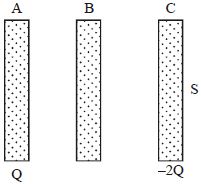
- 6Three identical metal plates with large surface areas are kept parallel to each other as shown in figure. The left most plates is given a charge $Q$ and the right most plate $C$ is given a charge $-2Q.$ The middle plate $B$ is neutral. Then the charge appearing on the outer surface $S$ of the plate $C$ is :-View Solution
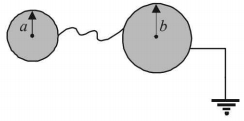
- 7Two conducting shells of radius $a$ and $b$ are connected by conducting wire as shown in figure. The capacity of system is :View Solution
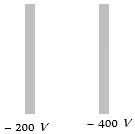
- 8View SolutionIn the following figure two parallel metallic plates are maintained at different potential. If an electron is released midway between the plates, it will move
- 9How much work is required to carry a $6$ $\mu C$ charge from the negative terminal to the positive terminal of a $9\, V$ batteryView Solution
- 10A sphere of radius $1\,cm$ has potential of $8000\,V$, then energy density near its surface will beView Solution