Question
An electric dipole in a uniform electric field experiences (When it is placed at an angle θ  with the field)(a) Force and torque both(b) Force but no torque(c) Torque but no force(d) No force and no torque


Answer

(c) Torque but no force

Need a full question paper?

Generate a complete, print-ready paper with questions like this in minutes — across 16+ boards, with answer keys.
Start Generating Free

Similar questions

In an ac circuit, current $I=5 \sin \left(100 t-\frac{\pi}{2}\right)$ ampere and altemating potential difference is $V =200$ sin ( 100 t ). The power dissipated in the circuit is :
If a magnet of length $10 \ cm$ and pole strength $40 \mathrm{A}-\mathrm{m}$ is placed at an angle of $45^{\circ} \mathrm{in}$ an uniform induction field of intensity $2 \times 10^{-4} \mathrm{T}$, the couple acting on it is
The maximum intensity in Young's double slit experiment is $I_0$. Distance between the slits is $d = 5 l,$ where $l$ is the wavelength of monochromatic light used in the experiment. What will be the intensity of light in front of one of the slits on a screen at a distance $D = 10d$
Smaller pieces of heavy stones and metals which on entering earth's atmosphere burns out are (a) Comets(b) Meteorites(c) Asteroids(d) All of these
       
Assertion  :   Conductors having equal positive charge and volume, must also have same potential.
Reason     :   Potential depends only on charge and volume of conductor. (a) If both assertion and reason are true and the reason is the correct explanation of the assertion.(b) If both assertion and reason are true but reason is not the correct explanation of the assertion.(c) If assertion is true but reason is false.(d) If the assertion and reason both are false.


Relativistic corrections become neccssary when the expression for the kinetic energy $\frac{1}{2}\text{mv}^2$, becomes comparable with $mc^2,$ where m is the mass of the particle. At what de Broglie wavelength will relativistic corrections become important for an electron?
Which of the following statements is correct(a) The current in a photocell increases with increasing frequency of light(b) The photocurrent is proportional to applied voltage(c) The photocurrent increases with increasing intensity of  light(d) The stopping potential increases with increasing intensity of incident light


If $P$ and $Q$ are two batteries connected in series with anode of one connected to anode of the other, producing voltages $E_1$ and $E_2>E_1$ respectively. The e.m.f of the pair is
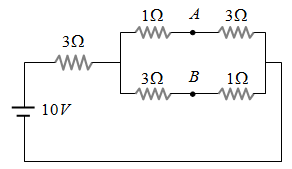
A battery of $e.m.f. 10 V$ is connected to resistance as shown in figure. The potential difference $V_A-V_B$  between the points $A$ and $B$ is
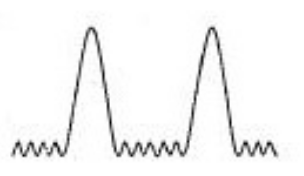
The figure shows diffraction pattern of two nearby points. The two points are: