An electric dipole is formed by two charges $+q$ and $-q$ located in xy-plane at $(0,2) \mathrm{mm}$ and $(0,-2) \mathrm{mm}$, respectively, as shown in the figure. The electric potential at point $\mathrm{P}(100,100) \mathrm{mm}$ due to the dipole is $V_0$. The charges $+q$ and $-q$ are then moved to the points $(-1,2) \mathrm{mm}$ and $(1,-2) \mathrm{mm}$, respectively. What is the value of electric potential at $P$ due to the new dipole?
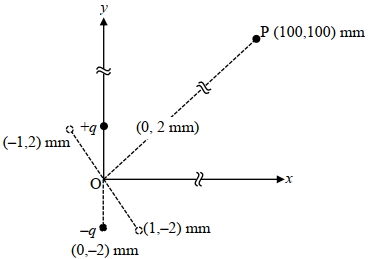
IIT 2023, Medium
Download our app for free and get started
(IMAGE)
$\mathrm{P}_1=\mathrm{q}(4)$
$\overrightarrow{\mathrm{P}}_1=\mathrm{P}_1 \hat{\mathrm{j}}$
$\overrightarrow{\mathrm{r}}=100(\hat{\mathrm{i}}+\hat{\mathrm{j}}) \mathrm{mm}$
$\mathrm{v}_0=\frac{K \mathrm{P}_1 \cdot \overrightarrow{\mathrm{r}}}{\mathrm{r}^3}=\frac{\mathrm{K}\left(100 \mathrm{P}_1\right)}{(100 \sqrt{2})^3}$
(IMAGE)
$\tan \theta=2$
$\overrightarrow{\mathrm{P}}_2=\mathrm{P}_2[-\cos \theta \hat{\mathrm{i}}+\sin \theta \hat{\mathrm{j}}]$
$\overrightarrow{\mathrm{r}}=100(\hat{\mathrm{i}}+\hat{\mathrm{j}}) \mathrm{mm}$
$\mathrm{P}_2=\mathrm{q} \ell$
$\mathrm{v}=\frac{\mathrm{K} \overrightarrow{\mathrm{P}}_2 \cdot \overrightarrow{\mathrm{r}}}{\mathrm{r}^3}$
$\mathrm{v}=\frac{\mathrm{K}\left(100 \mathrm{P}_2\right)-(-\cos \theta+\sin \theta)}{(100 \sqrt{2})^3}$
$\frac{\mathrm{v}_0 \mathrm{P}_2}{\mathrm{P}_1}=(-\cos \theta+\sin \theta)$
$\mathrm{v}=\mathrm{v}_0 \frac{\mathrm{q} \ell}{\mathrm{q}(4)}[-\cos \theta+\sin \theta]$
$=\frac{\mathrm{v}_0}{4}[-2+4]=\frac{\mathrm{v}_0}{2}$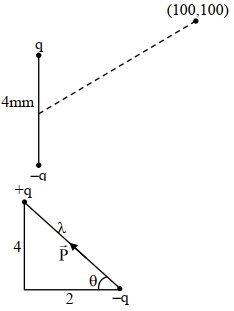

Download our appand get started for free
Experience the future of education. Simply download our apps or reach out to us for more information. Let's shape the future of learning together!No signup needed.*
Similar Questions
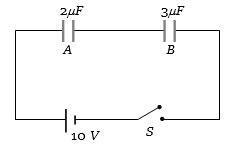
- 1Two capacitors $A$ and $B$ are connected in series with a battery as shown in the figure. When the switch $S$ is closed and the two capacitors get charged fully, thenView Solution
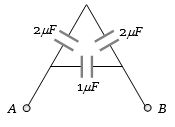
- 2What is the effective capacitance between $A$ and $B$ in the following figure........$\mu \,F$View Solution
- 3A $10\,\mu F$ capacitor is charged to a potential difference of $1000\, V$. The terminals of the charged capacitor are disconnected from the power supply and connected to the terminals of an uncharged $6\, \mu F$ capacitor. What is the final potential difference across each capacitor?......$V$View Solution
- 4In the circuit shown in figure, four capacitors are connected to a battery. The maximum energy is stored in the capacitor of.....$\mu F$View Solution
- 5Two identical thin rings each of radius $R$ meters are coaxially placed at a distance $R$ meters apart. If $Q_1$ coulomb and $Q_2$ coulomb are respectively the charges uniformly spread on the two rings, the work done in moving a charge $q$ from the centre of one ring to that of other isView Solution
- 6Two parallel plate capacitor with different plate seperation but the same capacitance are connected in series to a battery. Both capacitors are filled with air. The quantity that is $NOT$ the same for both the capacitors when they are fully charged isView Solution
- 7The variation of electrostatic potential with radial distance $r$ from the centre of a positively charged metallic thin shell of radius $R$ is given by the graphView Solution
- 8The radii of the inner and outer spheres of a condenser are $9\,cm$ and $10\,cm$ respectively. If the dielectric constant of the medium between the two spheres is $6$ and charge on the inner sphere is $18 \times {10^{ - 9}}\;coulomb$, then the potential of inner sphere will be, if the outer sphere is earthed........$volts$View Solution
- 9$27$ similar drops of mercury are maintained at $10 \,V$ each. All these spherical drops combine into a single big drop. The potential energy of the bigger drop is ....... times that of a smaller drop.View Solution
- 10A $4\ \mu F$ capacitor, a resistance of $2.5 \,MW$$\Omega$ is in series with $12\, V$ battery. Find the time after which the potential difference across the capacitor is $3$ times the potential difference across the resistor.......$s$ [Given $ln(2)= 0.693$]View Solution