A $10\,\mu F$ capacitor is charged to a potential difference of $1000\, V$. The terminals of the charged capacitor are disconnected from the power supply and connected to the terminals of an uncharged $6\, \mu F$ capacitor. What is the final potential difference across each capacitor?......$V$
Medium


Download our appand get started for free
Experience the future of education. Simply download our apps or reach out to us for more information. Let's shape the future of learning together!No signup needed.*
Similar Questions
- 1Force acting upon a charged particle kept between the plates of a charged condenser is $F$. If one plate of the condenser is removed, then the force acting on the same particle will becomeView Solution
- 2Two parallel plates have equal and opposite charge. When the space between them is evacuated, the electric field between the plates is $2 \times {10^5}\,V/m$. When the space is filled with dielectric, the electric field becomes $1 \times {10^5}\,V/m$. The dielectric constant of the dielectric materialView Solution
- 3The total charge on the system of capacitance $C _{1}=1\,\mu F , C _{2}=2\,\mu F , C _{3}=4\,\mu F$ and $C _{4}=3\,\mu F$ connected in parallel is $......\mu C$ (Assume a battery of $20\,V$ is connected to the combination)View Solution
- 4A parallel plate capacitor whose capacitance $C$ is $14\, pF$ is charged by a battery to a potential difference $V =12\, V$ between its plates. The charging battery is now disconnected and a porcelin plate with $k =7$ is inserted between the plates, then the plate would oscillate back and forth between the plates with a constant mechanical energy of $..........pJ$. (Assume no friction)View Solution
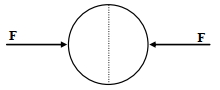
- 5A uniformly charged thin spherical shell of radius $\mathrm{R}$ carries uniform surface charge density of $\sigma$ per unit area. It is made of two hemispherical shells, held together by pressing them with force $\mathrm{F}$ (see figure). $\mathrm{F}$ is proportional toView Solution
- 6An air capacitor of capacity $C = 10\,\mu F$ is connected to a constant voltage battery of $12\,V$. Now the space between the plates is filled with a liquid of dielectric constant $5$. The charge that flows now from battery to the capacitor is......$\mu C$View Solution
- 7Three condensers each of capacitance $2F$ are put in series. The resultant capacitance is.........$F$View Solution
- 8The parallel combination of two air filled parallel plate capacitors of capacitance $C$ and $nC$ is connected to a battery of voltage, $V$. When the capacitor are fully charged, the battery is removed and after that a dielectric material of dielectric constant $K$ is placed between the two plates of the first capacitor. The new potential difference of the combined system isView Solution
- 9There is a uniformly charged non conducting solid sphere made of material of dielectric constant one. If electric potential at infinity be zero, then the potential at its surface is $V$. If we take electric potential at its surface to be zero, then the potential at the centre will beView Solution
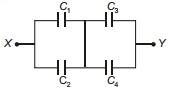
- 10In the circuit shown below $C_1=10 \,\mu F , C_2=C_3=20 \,\mu F$, and $C_4=40 \,\mu F$. If the charge on $C_1$ is $20 \,\mu C$ then potential difference between $X$ and $Y$ is ......... $V$View Solution