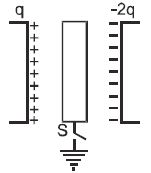
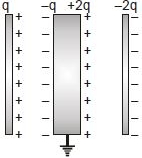
The metal plate on the left in figure carries a charge $+q$. The metal plate on the right has a charge of $-2q$. What charge will flow through $S$ when it is closed, if central plate is initially neutral
Easy


Download our appand get started for free
Experience the future of education. Simply download our apps or reach out to us for more information. Let's shape the future of learning together!No signup needed.*
Similar Questions
- 1A $5.0\, \mu F$ capacitor is charged to a potential difference $800\, V$ and discharged through a conductor. The energy(in $J$) given to a conductor during the discharge isView Solution
- 2A $40$ $\mu F$ capacitor in a defibrillator is charged to $3000\,V$. The energy stored in the capacitor is sent through the patient during a pulse of duration $2\,ms$. The power delivered to the patient is......$kW$View Solution
- 3A capacitor is half filled with a dielectric $(K=2)$ as shown in figure A. If the same capacitor is to be filled with same dielectric as shown, what would be the thickness of dielectric so that capacitor still has same capacity?View Solution
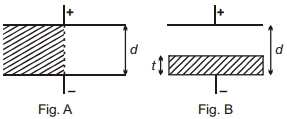
- 4The capacity of a parallel plate condenser is $10\,\mu F$ without dielectric. Dielectric of constant $2$ is used to fill half the distance between the plates, the new capacitance in $\mu F$ isView Solution
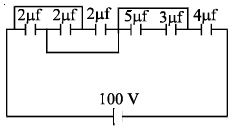
- 5In the circuit shown in figure charge stored in the capacitor of capacity $5\ \mu f$ is......$ \mu C$View Solution
- 6Assertion $(A):$ A spherical equipotential surface is not possible for a point charge.View Solution
Reason $(R):$ A spherical equipotential surface is possible inside a spherical capacitor.
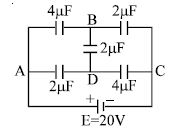
- 7The figure shows a diagonal symmetric arrangement of capacitors and a battery. If the potential of $C$ is zero, thenView Solution
- 8An $\alpha$ particle and a proton are accelerated from rest through the same potential difference. The ratio of linear momenta acquired by above two particals will be.View Solution
- 9If there are $n$ capacitors in parallel connected to $V$ volt source, then the energy stored is equal toView Solution
- 10View SolutionIf the distance between parallel plates of a capacitor is halved and dielectric constant is doubled then the capacitance will become