An electric field $\vec E\, = (25 \hat i + 30 \hat j)\,NC^{-1}$ exists in a region of space. If the potential at the origin is taken to be zero then the potential at $x\, = 2\, m, y\, = 2\, m$ is......$volt$
JEE MAIN 2015, Medium


Download our appand get started for free
Experience the future of education. Simply download our apps or reach out to us for more information. Let's shape the future of learning together!No signup needed.*
Similar Questions
- 1Two capacitors of $1\,\mu F$ and $2\,\mu F$ are connected in series, the resultant capacitance will be.....$\mu \,F$View Solution
- 2The radius of nucleus of silver (atomic number $=$ $47$) is $3.4 \times {10^{ - 14}}\,m$. The electric potential on the surface of nucleus is $(e = 1.6 \times {10^{ - 19}}\,C)$View Solution
- 3An infinite nonconducting sheet of charge has a surface charge density of $10^{-7}\ C/m^2$. The separation between two equipotential surfaces near the sheet whose potential differ by $ 5\,V$ isView Solution
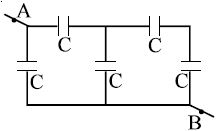
- 4What is the equivalent capacitance of the system of capacitors between $A$ $\&$ $B$View Solution
- 5Energy per unit volume for a capacitor having area $A$ and separation $d$ kept at potential difference $V$ is given byView Solution
- 6A capacitor of capacitance $C$ is charged to potential difference $V_0$. Now this capacitor is connected to an ideal inductor. When $25\%$ of energy of capacitor is transferred to inductor then at that time what will be potential difference across capacitorView Solution
- 7The work done in placing a charge of $8 \times {10^{ - 18}}$ coulomb on a condenser of capacity $100\, micro-farad$ isView Solution
- 8A force $F$ acts between sodium and chlorine ions of salt (sodium chloride) when put $1\,cm$ apart in air. The permittivity of air and dielectric constant of water are ${\varepsilon _0}$ and $K$ respectively. When a piece of salt is put in water electrical force acting between sodium and chlorine ions $1\,cm$ apart isView Solution
- 9If potential (in volts) in a region is expressed as $V (x,y,z) =6xy-y+2yz $ the electric field (in $N/C$) at point $(1, 1, 0)$ isView Solution
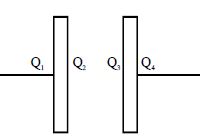
- 10In an insulated parallel-plate capacitor of capacitance $C$, the four surfaces have charges $Q_1, Q_2, Q_3$ and $Q_4$ as shown. The potential difference between the plate isView Solution