MCQ
An electric lift with a maximum load of $2000\,kg$ (lift+ passengers) is moving up with a constant speed of $1.5\,ms ^{-1}$. The frictional force opposing the motion is $3000\,N$. The minimum power delivered by the motor to the lift in watts is: $\left(g=10\,ms^{-2}\right)$
  • A
    $20000$
  • $34500$
  • C
    $23500$
  • D
    $23000$

Answer

Correct option: B.
$34500$
b
Constant velocity $\Rightarrow a =0$

$\Rightarrow T = W + f$

$=20000+3000$

$=23000\,N$

$\text { Power } = Tv$

$=23000 \times 1.5$

$=34500 \text { watts }$

Need a full question paper?

Generate a complete, print-ready paper with questions like this in minutes — across 16+ boards, with answer keys.

Start Generating Free

Similar questions

The height of any point $P$ above the surface of earth is equal to diameter of earth. The value of acceleration due to gravity at point $P$ will be : (Given $g=$ acceleration due to gravity at the surface of earth)
Three particles, located initially on the vertices of an equilateral triangle of side $L,$ start moving with a constant tangential acceleration towards each other in a cyclic manner, forming spiral loci that coverage at the centroid of the triangle. The length of one such spiral locus will be
A ball is thrown vertically upwards from the top of a tower with a velocity $u$. This ball  reaches the ground level with a velocity $4\,u$. The height of the tower is 
According to Reynolds, what will be the value of critical velocity?
Amount of heat required to raise the temperature of a body through $1^oC$ is called its
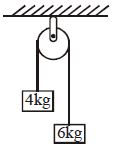
For the pulley system the kinetic energy of the $6\,kg$ block after $5\,s$ is ............ $\mathrm{J}$
A force of $6.4\, N$ stretches a vertical spring by $0.1 \,m$. The mass that must be suspended from the spring so that it oscillates with a period of $\left( {\frac{\pi }{4}} \right)sec$. is  ... $kg$
An ideal gas at pressure $P$ and volume $V$ is expanded to volume$ 2V.$ Column $I$ represents the thermodynamic processes used during expansion. Column $II$ represents the work during these processes in the random order.:

Column $I$ Column $II$
 $(p)$ isobaric $(x)$ $\frac{{PV(1 - {2^{1 - \gamma }})}}{{\gamma  - 1}}$
$(q)$ isothermal $(y)$ $PV$
$(r)$ adiabatic (z) $PV\,\iota n\,2$

The correct matching of column $I$ and column $II$ is given by 

Which of the following functions for $y$ can never represent a travelling wave?

$(a)$ $\left(x^2-v t\right)^2$

$(b)$ $\log \left[\frac{(x+v t)}{x_0}\right]$

$(c)$ $e^{\left\{-\frac{(x+v t)}{x_0}\right\}^2}$

$(d)$ $\frac{1}{x+v t}$

What is the path followed by a moving body, on which a constant force acts in a direction other than initial velocity (i.e. excluding parallel and antiparallel direction)?