Question
An electromagnetic waves can be produced, when charge is:

Answer

  1. both (b) and (c)
Explanation:
An accelerated charge is the source of electromagnetic waves (EMWs). When the charge is in a circular motion, the direction of its velocity continuously changes and thus it is in accelerated motion and produces EMWs.
A charge falling in an electric field is accelerated by the electric force and thus produces EMWs.

Need a full question paper?

Generate a complete, print-ready paper with questions like this in minutes — across 16+ boards, with answer keys.
Start Generating Free

Similar questions

We are able to obtain fairly large currents in a conductor because(a) The electron drift speed is usually very large(b) The number density of free electrons is very high and this can compensate for the low values of the electron drift speed and the very small magnitude of the electron charge(c) The number density of free electrons as well as the electron drift speeds are very large and these compensate for the very small magnitude of the electron charge(d) The very small magnitude of the electron charge has to be divided by the still smaller product of the number density and drift speed to get the electric current


In a transformer, the number of turns in primary coil and secondary coil are 5 and 4 respectively. If 240 V is applied on the primary coil, then the ratio of current in primary and secondary coil is
The magnetic susceptibility for diamagnetic materials is:
In a CRT the acceleration of electrons is controlled by changing ________ between the cathode and anode:
Assertion  :   The specific charge of positive rays is not constant.
Reason      : The mass of ions varies with speed.(a) If both assertion and reason are true and the reason is the correct explanation of the assertion.(b) If both assertion and reason are true but reason is not the correct explanation of the assertion.(c) If assertion is true but reason is false.(d) If the assertion and reason both are false.


A convex lens of focal length 40 cm is in contact with a concave lens of focal length 25 cm. The power of combination is
Two galvanometers A and B require 3mA and 5mA respectively to produce the same deflection of 10 divisions. Then(a) A is more sensitive than B(b) B is more sensitive than A(c) A and B are equally sensitive(d) Sensitiveness of B is 5/3 times that of A
   
   
Which of the following is used in optical fibers?
An object 5 cm tall is placed 1m from a concave spherical mirror which has a radius of curvature of 20 cm The size of the image is(a) 0.11 cm(b) 0.50 cm(c) 0.55 cm(d) 0.60 cm
       
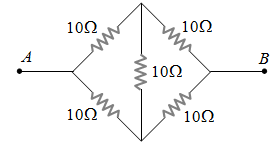
The effective resistance between points $A$ and $B$ is