MCQ
An electromagnetic waves can be produced, when charge is:
- AMoving with constant velocity
- BMoving in a circular orbit
- CFalling in an electric field
- Dboth (b) and (c)
Explanation:
An accelerated charge is the source of electromagnetic waves (EMWs). When the charge is in a circular motion, the direction of its velocity continuously changes and thus it is in accelerated motion and produces EMWs.
A charge falling in an electric field is accelerated by the electric force and thus produces EMWs.
Generate a complete, print-ready paper with questions like this in minutes — across 16+ boards, with answer keys.
In a copper voltameter experiment, current is decreased to one-fourth of the initial value but it is passed for four times the earlier duration. Amount of copper deposited will be
|
(a) Same |
(b) One-fourth the previous value |
|
(c) Four times the previous value |
(d) |
In a conductor 4 coulombs of charge flows for 2 seconds. The value of electric current will be
|
(a) 4 volts |
(b) 4 amperes |
(c) 2 amperes |
(d) 2 volts |
The magnetic flux linked with a coil at any instant ‘t’ is given by f = 5t3 – 100t + 300, the e.m.f. induced in the coil at t = 2 second is
|
(a) – 40 V |
(b) 40 V |
(c) 140 V |
(d) 300 V |
$\frac{\text{v}}{4}$
$\frac{\text{v}}{2}$
$\text{v}$
$2\text{v}$
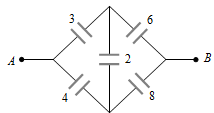
Effective capacitance between A and B in the figure shown is (all capacitance are in mF)
|
(a) 21 mF |
(b) 23 mF |
(c) |
(d) |
We are able to obtain fairly large currents in a conductor because
|
(a) The electron drift speed is usually very large |
|
(b) The number density of free electrons is very high and this can compensate for the low values of the electron drift speed and the very small magnitude of the electron charge |
|
(c) The number density of free electrons as well as the electron drift speeds are very large and these compensate for the very small magnitude of the electron charge |
|
(d) The very small magnitude of the electron charge has to be divided by the still smaller product of the number density and drift speed to get the electric current |
 amp is flowing through a resistance of 1000Ω. To measure the correct potential difference, the voltmeter is to be used of which the resistance should be
|
(a) 0 Ω |
(b) 500 Ω |
(c) 1000 Ω |
(d) >> 1000 Ω |


