An electron and a proton have equal kinetic energies. They enter in a magnetic field perpendicularly, Then
Easy
Download our app for free and get started
(d) Particles entering perpendicularly, hence they will describe circular path. Since their masses are different so they will describe path of different radii.

Download our appand get started for free
Experience the future of education. Simply download our apps or reach out to us for more information. Let's shape the future of learning together!No signup needed.*
Similar Questions
- 1View SolutionA proton and an alpha particle of the same enter in a uniform magnetic field which is acting perpendicular to their direction of motion. The ratio of the circular paths described by the alpha particle and proton is ....
- 2A particle of specific charge $(q/m)$ is projected from the origin of coordinates with initial velocity $[ui - vj]$. Uniform electric magnetic fields exist in the region along the $+y$ direction, of magnitude $E$ and $B.$ The particle will definitely return to the origin once ifView Solution
- 3A current of $I$ $ampere$ is passed through a straight wire of length $2.0$ $metres$. The magnetic field at a point in air at a distance of $3$ $metres$ from either end of wire and lying on the axis of wire will beView Solution
- 4View SolutionWhich of the following gives the value of magnetic field according to, Biot-Savart’s law’
- 5View SolutionA current carrying rectangular coil is placed in a uniform magnetic field. In which orientation, the coil will not tend to rotate
- 6View SolutionThe magnetic moment of a circular coil carrying current is
- 7${10^{ - 3}}amp$ is flowing through a resistance of $1000\,\Omega $. To measure the correct potential difference, the voltmeter is to be used of which the resistance should beView Solution
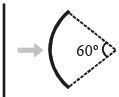
- 8A magnetised wire of moment $M$ is bent into an arc of a circle subtending an angle of $60^o$ at the centre; then the new magnetic moment isView Solution
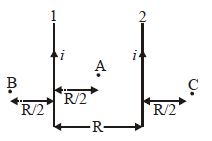
- 9Two long parallel wires are at a distance $R$ apart. They carry steady equal currents in the same directions as shown in the figure. The ratio of magnetic fields at $A, B$ and $C$ respectively, isView Solution
- 10Two thin long parallel wires separated by a distance $b$ are carrying a current $i$ $amp$ each. The magnitude of the force per unit length exerted by one wire on the other isView Solution