An electron beam passes through a magnetic field of $2 \times 10^{-3}\,Wb/m^2$ and an electric field of $1.0 \times 10^4\,V/m$ both acting simultaneously. The path of electron remains undeviated. The speed of electron if the electric field is removed, and the radius of electron path will be respectively
AIIMS 2011, Medium
Download our app for free and get started
$\mathrm{B}=2 \times 10^{-3}\, \mathrm{Wb} / \mathrm{m}^{2}$
$\mathrm{E}=1 \times 10^{4}\, \mathrm{V} / \mathrm{m}^{2}$
Since the path of electron remains undeviated, $\mathrm{qvB}=\mathrm{q} \mathrm{E}$ or
$\mathrm{v}=\frac{\mathrm{E}}{\mathrm{B}}=\frac{1 \times 10^{14}}{2 \times 10^{-3}}=0.5 \times 10^{7}$
$=5 \times 10^{6}\, \mathrm{m} / \mathrm{s}$
If the electricfield is removed, the path of the charged particle is circular and magnetic field provides the necessary centripetal force.
i.e., $\frac{\mathrm{mv}^{2}}{\mathrm{r}}=\mathrm{Bev} \Rightarrow \quad \mathrm{r}=\frac{\mathrm{mv}}{\mathrm{Be}}$
$=\frac{9.1 \times 10^{-31} \times 5 \times 10^{6}}{2 \times 10^{-3} \times 1.6 \times 10^{-19}}$
$=14.3 \times 10^{-3}\, \mathrm{m}=1.43\, \mathrm{cm}$

Download our appand get started for free
Experience the future of education. Simply download our apps or reach out to us for more information. Let's shape the future of learning together!No signup needed.*
Similar Questions
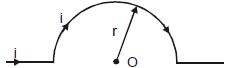
- 1A portion of a conductive wire is bent in the form of a semicircle of radius $r$ as shown below in fig. At the centre of semicircle, the magnetic induction will beView Solution
- 2A thin circular wire carrying a current $I$ has a magnetic moment $M$. The shape of the wire is changed to a square and it carries the same current. It will have a magnetic momentView Solution
- 3A straight wire carrying a current $10\, A$ is bent into a semicircular arc of radius $5\, cm.$ The magnitude of magnetic field at the center isView Solution
- 4A galvanometer coil has $500$ turns and each turn has an average area of $3 \times 10^{-4}\, m ^{2}$. If a torque of $1.5\,Nm$ is required to keep this coil parallel to magnetic field when a current of $0.5\, A$ is flowing through it, the strength of the field (in $T )$ isView Solution
- 5A charge moving with velocity $v$ in $X$-direction is subjected to a field of magnetic induction in the negative $X$-direction. As a result, the charge willView Solution
- 6A particle having charge of $1 \,\,C$, mass $1 \,\,kg$ and speed $1 \,\,m/s$ enters a uniform magnetic field, having magnetic induction of $1$ $T,$ at an angle $\theta = 30^o$ between velocity vector and magnetic induction. The pitch of its helical path is (in meters)View Solution
- 7A long solenoid has $200$ turns per cm and carries a current of $2.5\, amps$. The magnetic field at its centre is $({\mu _0} = 4\pi \times {10^{ - 7}}\,weber/amp{\rm{ - }}m)$View Solution
- 8A charged particle carrying charge $1\,\mu C$ is moving with velocity $(2 \hat{ i }+3 \hat{ j }+4 \hat{ k })\, ms ^{-1} .$ If an external magnetic field of $(5 \hat{ i }+3 \hat{ j }-6 \hat{ k }) \times 10^{-3}\, T$ exists in the region where the particle is moving then the force on the particle is $\overline{ F } \times 10^{-9} N$. The vector $\overrightarrow{ F }$ is :View Solution
- 9Which one of the following modifications may ncrease the sensitivity of moving coil galvanometer?View Solution
$1^{st}$ Way : By using spring of smaller torsion constant.
$2^{nd}$ Way : By using a smaller coil
$3^{rd}$ Way : By using a stronger magnet
$4^{th}$ Way : By using a coil having fewer number of turns. - 10Suppose an isolated north pole is kept at the centre of a circular loop carrying a electric current $i$. The magnetic field due to the north pole at a point on the periphery of the wire is $B$. The radius of the loop is $a$. The force on the wire isView Solution