A charge moving with velocity $v$ in $X$-direction is subjected to a field of magnetic induction in the negative $X$-direction. As a result, the charge will
AIPMT 1993, Easy
Download our app for free and get started
(a) $\overrightarrow {{F_m}} = q\,(\overrightarrow {v\,} \times \overrightarrow B )$
When the angle between $\overrightarrow {v\,} $ and $\overrightarrow B \,is\, 180^o, F_m = 0$
When the angle between $\overrightarrow {v\,} $ and $\overrightarrow B \,is\, 180^o, F_m = 0$

Download our appand get started for free
Experience the future of education. Simply download our apps or reach out to us for more information. Let's shape the future of learning together!No signup needed.*
Similar Questions
- 1A teacher in his physics laboratory allotted an experiment to determine the resistance $(G)$ of a galvanometer. Students took the observations for $\frac{1}{3}$ deflection in the galvanometer. Which of the below is true for measuring value of $G$ $?$View Solution
- 2The resistance of a galvanometer is $50\, ohms$ and the current required to give full scale deflection is $100\,\mu A$. In order to convert it into an ammeter, reading upto $10\,A$, it is necessary to put a resistance ofView Solution
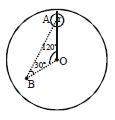
- 3The figure shows the cross section of a long cylindrical conductor through which an axial hole of radius $r$ is drilled with its centre at point $A$ . $O$ is the centre of the conductor. If an identical hole were to be drilled centred at point $B$ while maintaining the same current density the magnitude of magnetic field at $O$View Solution
- 4A galvanometer whose resistance is $120\,\Omega $ gives full scale deflection with a current of $0.05\, A$ so that it can read a maximum current of $10\, A$. A shunt resistance is added in parallel with it. The resistance of the ammeter so formed is .............. $\Omega $View Solution
- 5Statement $-1$ : Path of the charge particle may be straight line in uniform magnetic field.View Solution
Statement $-2$ : Path of the charge particle is decided by the angle between its velocity and the magnetic force working on it - 6View SolutionThe motion of a charged particle can be used to distinguish between a magnetic field and electric field in a certain region by firing the charge
- 7A galvanometer has a resistance of $50\ \Omega$ and it allows maximum current of $5 \mathrm{~mA}$. It can be converted into voltmeter to measure upto $100 \mathrm{~V}$ by connecting in series a resistor of resistanceView Solution
- 8A proton of mass $1.67 \times {10^{ - 27}}\,kg$ and charge $1.6 \times {10^{ - 19}}\,C$ is projected with a speed of $2 \times {10^6}\,m/s$ at an angle of $60^\circ $ to the $X - $ axis. If a uniform magnetic field of $0.104$ $Tesla$ is applied along $Y - $ axis, the path of proton isView Solution
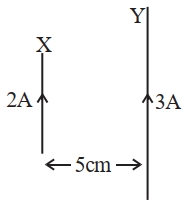
- 9A wire $X$ of length $50\; cm$ carrying a current of $2\,A$ is placed parallel to a long wire $Y$ of length $5\,m$. The wire $Y$ carries a current of $3\,A$. The distance between two wires is $5\,cm$ and currents flow in the same direction. The force acting on the wire $Y$ is.View Solution
- 10View SolutionThe shape of the magnetic field lines due to an infinite long, straight current carrying conductor is :