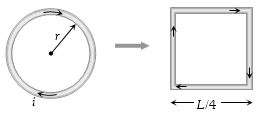
A thin circular wire carrying a current $I$ has a magnetic moment $M$. The shape of the wire is changed to a square and it carries the same current. It will have a magnetic moment
Medium


Download our appand get started for free
Experience the future of education. Simply download our apps or reach out to us for more information. Let's shape the future of learning together!No signup needed.*
Similar Questions
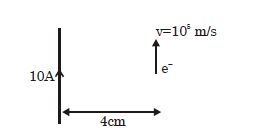
- 1An $e^-$ is moving parallel to a long current carrying wire as shown. Force on electron isView Solution
- 2An electron is revolving round a proton, producing a magnetic field of $16\, weber/m^2$ in a circular orbit of radius $1\,\mathop A\limits^o $. It’s angular velocity will beView Solution
- 3The cyclotron frequency of an electron grating in a magnetic field of $1\, T$ is approximatelyView Solution
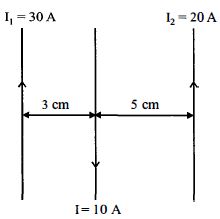
- 4Three straight parallel current carrying conductors are shown in the figure. The force experienced by the middle conductor of length $25\,cm$ isView Solution
- 5A charge $+ Q$ is moving upwards vertically. It enters a magnetic field directed to the north. The force on the charge will be towardsView Solution
- 6View SolutionThe current sensitivity of a moving coil galvanometer can be increased by
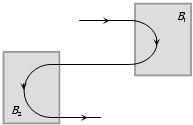
- 7Following figure shows the path of an electron that passes through two regions containing uniform magnetic fields of magnitudes $B_1$ and $B_2$. It's path in each region is a half circle, choose the correct optionView Solution
- 8When a resistance of $5\,\Omega$ is shunted with a moving coil galvanometer, it shows a full scale deflection for a current of $250\,mA$, however when $1050\,\Omega$ resistance is connected with it in series, it gives full scale deflection for $25$ volt. The resistance of galvanometer is $......\,\Omega$.View Solution
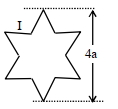
- 9A symmetric star conducting wire loop is carrying a steady state current $\mathrm{I}$ as shown in figure. The distance between the diametrically opposite vertices of the star is $4 a$. The magnitude of the magnetic field at the center of the loop isView Solution
- 10If the maximum value of accelerating potential provided by a ratio frequency oscillator is $12\, {kV}$. The number of revolution made by a proton in a cyclotron to achieve one sixth of the speed of light is ....... .View Solution
$\left[{m}_{{p}}=1.67 \times 10^{-27} {kg}, {e}=1.6 \times 10^{-19} {C},\right.$ Speed of light $\left.=3 \times 10^{8} {m} / {s}\right]$