Question
An electron emitted by a heated cathode and accelerated through a potential difference of 2.0 kV, enters a region with uniform magnetic field of 0.15 T. Determine the trajectory of the electron if the field,
  1. is transverse to its initial velocity,
  2. makes an angle of 30º with the initial velocity.
Answer

Magnetic field strength, $B = 0.15$ TCharge on the electron,$ e = 1.6 \times 10^{-19} C$
Mass of the electron, $m = 9.1 \times 10^{-31} kg$
Potential difference, $V = 2.0 kV = 2 \times 10^3 V$
Thus, kinetic energy of the electron $= eV$
$\Rightarrow\text{eV}=\frac{1}{2}\text{mv}^{2}$
$\text{v}=\sqrt\frac{2\text{ev}}{\text{m}}.........(1)$
Where,
v = velocity of the electron
  1. Magnetic force on the electron provides the required centripetal force of the electron. Hence, the electron traces a circular path of radius r.
Magnetic force on the electron is given by the relation,
$\text{B ev}$
$\text{Centripetal force}=\frac{\text{mv}^{2}}{\text{r}}$
$\therefore\text{Bev}=\frac{\text{mv}^{2}}{\text{r}}$
$\text{r}=\frac{\text{mv}}{\text{Be}}.........(2)$
From equations (1) and (2), we get
$\text{r}=\frac{\text{m}}{\text{Be}}\Big[\frac{2\text{ev}}{\text{m}}\Big]^{\frac{1}{2}}$
$=\frac{9.1\times10^{-31}}{0.15\times1.6\times10^{-19}}\times\Big(\frac{2\times1.6\times10^{-19}\times2\times10^{3}}{9.1\times10^{-31}}\Big)^{\frac{1}{2}}$
$=100.55\times10^{-5}$
$=1.01\times10^{-3}\text{m}$
$=1\text{mm}$
Hence, the electron has a circular trajectory of radius 1.0 mm normal to the magnetic field.
  1. When the field makes an angle θ of 30° with initial velocity, the initial velocity will be,
$\text{v}_{1}=\text{v}\sin\theta$
From equation (2), we can write the expression for new radius as: $\text{r}_{1}=\frac{\text{mv}_{1}}{\text{Be}}$
$=\frac{\text{mv}\sin\theta}{\text{Be}}$
$=\frac{9.1\times10^{-31}}{0.15\times1.6\times10^{-19}}\times\Big(\frac{2\times1.6\times10^{-19}\times2\times10^{3}}{9\times10^{-31}}\Big)^{\frac{1}{2}}\times\sin30^{\circ}$
$=0.5\times10^{-31}\text{m}$
$=0.5\text{mm}$
Hence, the electron has a helical trajectory of radius 0.5 mm along the magnetic field direction.

Need a full question paper?

Generate a complete, print-ready paper with questions like this in minutes — across 16+ boards, with answer keys.

Start Generating Free

Similar questions

A magnetic field of $(4.0\times10^{-3}\vec{\text{k}})$ T exerts a force of $(4.0\vec{\text{i}}+3.0\vec{\text{j}})\times10^{-10}$ N on a particle with a charge of $1.0\times10^{-9}\text{C}$ and going in the x−y plane. Find the velocity of the particle.
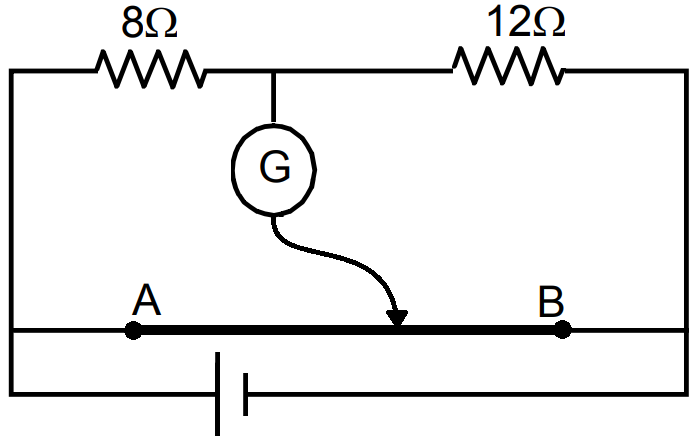
The potentiometer wire AB shown in the figure. is 40cm long. Where should the free end of the galvanometer be connected on AB so that the galvanometer may show zero deflection?
An electron of kinetic energy 100eV circulates in a path of radius 10cm in a magnetic field. Find the magnetic field and the number of revolutions per second made by the electron.
Light is incident from glass $(\mu=1.50)$ to water $(\mu=1.33).$ Find the range of the angle of deviation for which there are two angles of incidence.
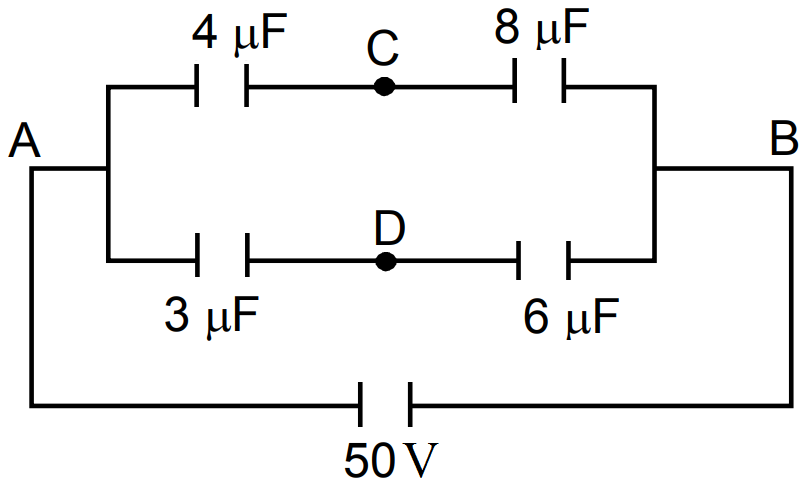
Take the potential of the point B in figure to be zero:
  1. Find the potentials at the points C and D.
  2. If a capacitor is connected between C and D, what charge will appear on this capacitor?
Consider an excited hydrogen atom in state n moving with a velocity u(ν << c). It emits a photon in the direction of its motion and changes its state to a lower state m. Apply momentum and energy conservation principles to calculate the frequency ν of the emitted radiation. Compare this with the frequency $ν_0$ emitted if the atom were at rest.
The current−voltage characteristic of an ideal p-n junction diode is given by $\text{i}=\text{i}_0\Big(\text{e}^{\frac{\text{eV}}{\text{kT}}}-1\Big)$ where, the drift current $i_0$ equals $10\mu\text{A}.$ Take the temperature T to be 300K.
  1. Find the voltage $V_0$ for which $\text{e}^{\frac{\text{eV}}{\text{KT}}}=100.$ One can neglect the term 1 for voltages greater than this value.
  2. Find an expression for the dynamic resistance of the diode as a function of V for $V > V_0.$
  3. Find the voltage for which the dynamic resistance is $0.2\Omega.$
A body of mass 2kg is lying on a rough inclined plane of inclination 30°. Find the magnitude of the force parallel to the incline needed to make the block move:
  1. Up the incline
  2. Down the incline. Coefficient of static friction = 0.2.
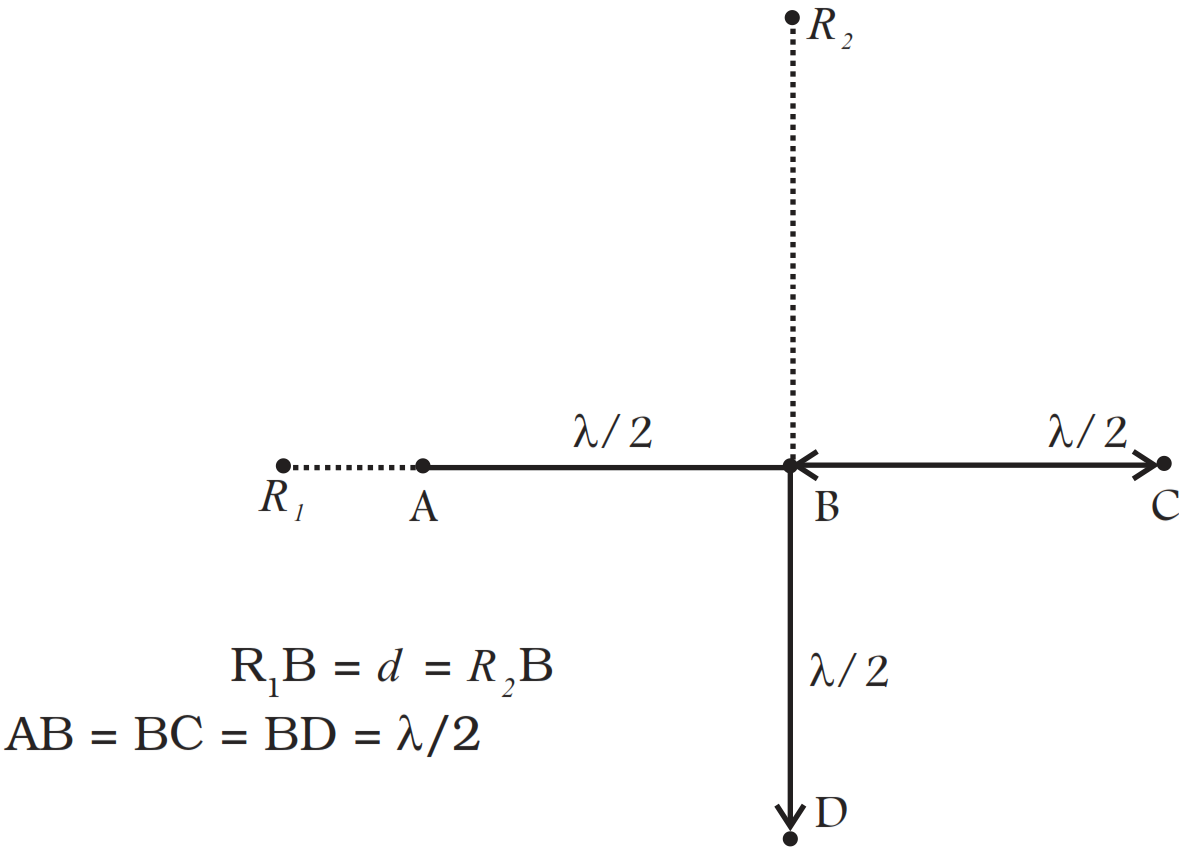
Four identical monochromatic sources A,B,C,D as shown in the (Fig.) produce waves of the same wavelength λ and are coherent. Two receiver $R_1$ and $R_2$ are at great but equal distaces from B.
  1. Which of the two receivers picks up the larger signal?
  2. Which of the two receivers picks up the larger signal when B is turned off?
  3. Which of the two receivers picks up the larger signal when D is turned off?
  4. Which of the two receivers can distinguish which of the sources B or D has been turned off?
A hemispherical portion of the surface of a solid glass sphere $(\mu=1.5)$ of radius r is silvered to make the inner side reflecting. An object is placed on the axis of the hemisphere at a distance 3r from the centre of the sphere. The light from the object is refracted at the unsilvered part, then reflected from the silvered part and again refracted at the unsilvered part. Locate the final image formed.