A hemispherical portion of the surface of a solid glass sphere $(\mu=1.5)$ of radius r is silvered to make the inner side reflecting. An object is placed on the axis of the hemisphere at a distance 3r from the centre of the sphere. The light from the object is refracted at the unsilvered part, then reflected from the silvered part and again refracted at the unsilvered part. Locate the final image formed.
Download our app for free and get started
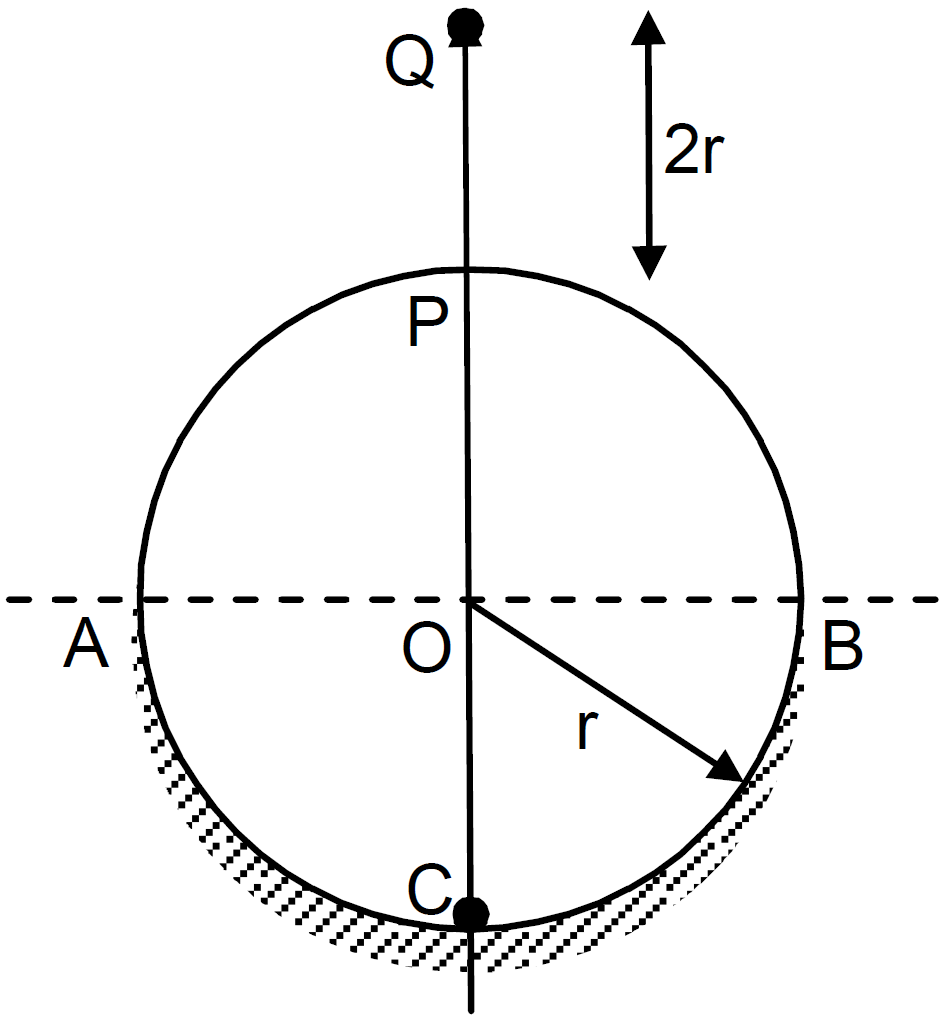
As shown in the figure, OQ = 3r, OP = r
So, PQ = 2r
For refraction at APB
We know, $\frac{\mu_2}{\text{v}}-\frac{\mu_1}{\text{u}}=\frac{\mu_2-\mu_1}{\text{R}}$
$\Rightarrow\frac{1.5}{\text{v}}-\Big(\frac{1}{-2\text{r}}\Big)=\frac{0.5}{\text{r}}=\frac{1}{2\text{r}}$ [because u = -2r]
$\Rightarrow\text{v}=\infty$
For the reflection in concave mirror
$\text{u}=\infty$
So, v = focal length of mirror $=\frac{\text{r}}{2}$
For the refraction of APB of the reflected image.
Here, $\text{u}=\frac{-3\text{r}}{2}$
$\frac{1}{\text{v}}-\frac{1.5}{\frac{-3\text{r}}{2}}=\frac{-0.5}{-\text{r}}$ $\big[\text{Here}, \ \mu_1=1.5 \ \text{and} \ \text{R}=-\text{r}\big]$
$\Rightarrow\text{v}=-2\text{r}$
As, negative sign indicates images are formed inside APB. So, image should be at C. So, the final image is formed on the reflecting surface of the sphere.

Download our appand get started for free
Experience the future of education. Simply download our apps or reach out to us for more information. Let's shape the future of learning together!No signup needed.*
Similar Questions
- 1A biconvex thick lens is constructed with glass $(\mu=1.50)$ Each of the surfaces has a radius of 10cm and the thickness at the middle is 5cm. Locate the image of an object placed far away from the lens.View Solution
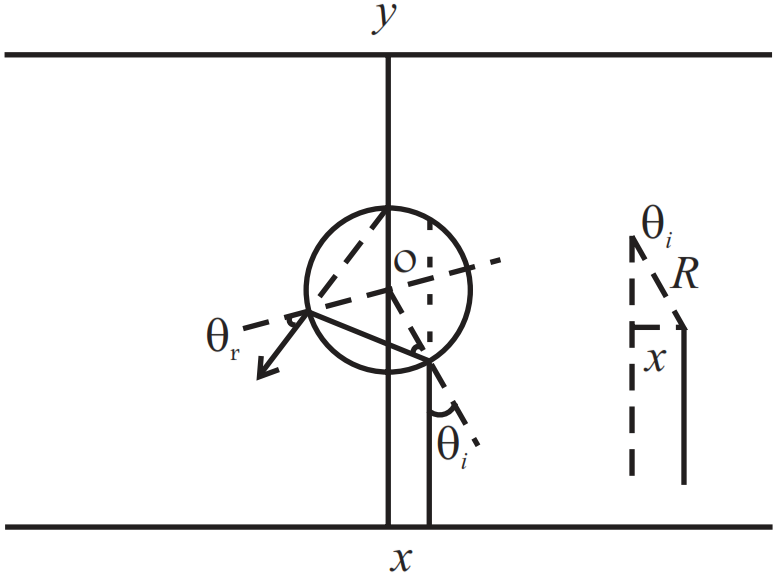
- 2View SolutionAn infinitely long cylinder of radius R is made of an unusual exotic material with refractive index -1 (Fig). The cylinder is placed between two planes whose normals are along the y direction. The center of the cylinder O lies along the y-axis. A narrow laser beam is directed along the y direction from the lower plate. The laser source is at a horizontal distance x from the diameter in the y direction. Find the range of x such that light emitted from the lower plane does not reach the upper plane.
- 3View SolutionLenses are constructed by a material of refractive index 1.50. The magnitude of the radii of curvature are 20cm and 30cm. Find the focal lengths of the possible lenses with the above specifications.
- 4View Solution
- Draw a ray diagram showing the image formation by a compound microscope. Hence obtain expression for total magnification when the image is formed at infinity.
- Distinguish between myopia and hypermetropia. Show diagrammatically how these defects can be corrected.
- 5A card sheet divided into squares each of size $1\ mm^2$ is being viewed at a distance of 9 cm through a magnifying glass (a converging lens of focal length 9 cm) held close to the eye.View Solution
- What is the magnification produced by the lens? How much is the area of each square in the virtual image?
- What is the angular magnification (magnifying power) of the lens?
- Is the magnification in (a) equal to the magnifying power in (b)? Explain.
- 6View Solution
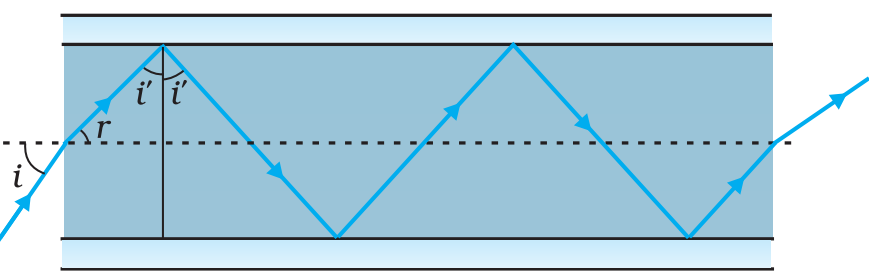
- a cross - section of a ‘light pipe’ made of a glass fibre of refractive. The outer covering of the pipe is made of a material of refractive. What is the range of the angles of the incident rays with the axis of the pipe for which total reflections inside the pipe take place, as shown in the figure.
- What is the answer if there is no outer covering of the pipe?
- 7Three immiscible liquids of densities $d_1 > d_2 > d_3$ and refractive indices $\mu _1 > \mu _2 > \mu _3$ are put in a beaker. The height of each liquid column is $\frac{\text{h}}{3}$. A dot is made at the bottom of the beaker. For near normal vision, find the apparent depth of the dot.View Solution
- 8View SolutionA point object is placed at a distance of 15cm from a convex lens. The image is formed on the other side at a distance of 30cm from the lens. When a concave lens is placed in contact with the convex lens, the image shifts away further by 30cm. Calculate the focal lengths of the two lenses.
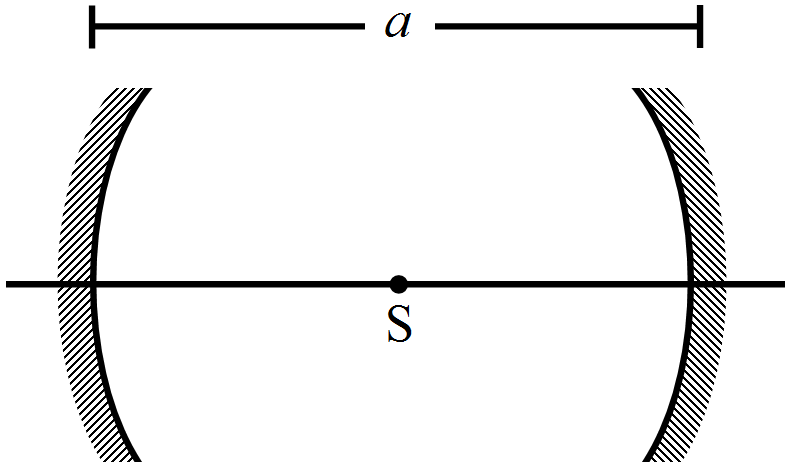
- 9View SolutionA point source S is placed midway between two converging mirrors having equal focal length f. Find the values of d for which only one image is formed.
- 10View SolutionA compound microscope consists of an objective lens of focal length 2.0 cm and an eyepiece of focal length 6.25 cm separated by a distance of 15 cm. How far from the objective should an object be placed in order to obtain the final image at (a) the least distance of distinct vision (25 cm), and (b) at infinity? What is the magnifying power of the microscope in each case?