Question
An electron in a hydrogen atom undergoes a transition from an orbit with quantum numebr $\mathrm{n}_i$ to another with quantum number $\mathrm{n}_f . \mathrm{V}_i$ and $\mathrm{V}_f$ are respectively the initial and final potential energies of the electon. If $\frac{\mathrm{v}_{\mathrm{i}}}{\mathrm{v}_{\mathrm{f}}}=6.25$, then the smallest possible $n_f$ is
Answer

$\frac{\mathrm{v}_{\mathrm{i}}}{\mathrm{v}_{\mathrm{f}}}=6.25$

$\Rightarrow\left(\frac{n_f}{n_i}\right)^2=6.25$

$\Rightarrow \frac{\mathrm{n}_{\mathrm{f}}}{\mathrm{n}_{\mathrm{i}}}=2.5=\frac{5}{2}$

$\Rightarrow$ minimum value of $n_f$ is $5$.

Need a full question paper?

Generate a complete, print-ready paper with questions like this in minutes — across 16+ boards, with answer keys.

Start Generating Free

Similar questions

The oscillation of a body on a smooth horizontal surface is represented by the equation $x= Acos$$\omega t$ 

where $x=$ displacement at time $t$

$\omega =$ frequency of oscillation

Which one of the following graphs shows correctly the variation $a$ with $t$ ?

Here $a=$ acceleration at time $t$

$T=$ time period

In a hollow spherical shell potential $(V)$ changes with respect to distance $(r)$ from centre
Four charges $ + Q,\, - Q,\, + Q,\, - Q$ are placed at the corners of a square taken in order. At the centre of the square
The original temperature of a black body is ${727^o}C.$The temperature at which this black body must be raised so as to double the total radiant energy, is ....... $K$
Assertion : Dipole oscillations produce electromagentic waves.

Reason : Accelerated charge produces electromagnetic waves.

Dispersion can take place for
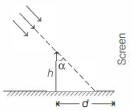
A long horizontal mirror is next to a vertical screen (seen figure). Parallel light rays are falling on the mirror at an angle $\alpha$ from the vertical. If a vertical object of height $h$ is kept on the mirror at a distance $(d > h) \tan \alpha$. The length of the shadow of the object on the screen would be
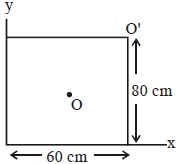
For a uniform rectangular sheet shown in the figure, the ratio of moments of inertia about the axes perpendicular to the sheet and passing through $O$ (the centre of mass) and $O ^{\prime}($ corner point $)$ is 
$Assertion$ : A body with constant acceleration always moves along a straight line.

$Reason$ : A body with constant acceleration may not speed up.

A car $P$ travelling at $20\,ms ^{-1}$ sounds its horn at a frequency of $400\,Hz$. Another car $Q$ is travelling behind the first car in the same direction with a velocity $40\,ms ^{-1}$. The frequency heard by the passenger of the car $Q$ is approximately $.......\,Hz$ [Take, velocity of sound $=360\,ms ^{-1}$ ]