Four charges $ + Q,\, - Q,\, + Q,\, - Q$ are placed at the corners of a square taken in order. At the centre of the square
Easy
Download our app for free and get started
(a) At centre
$E = 0$ and $V = 0$
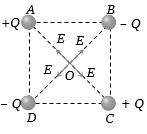
$E = 0$ and $V = 0$

Download our appand get started for free
Experience the future of education. Simply download our apps or reach out to us for more information. Let's shape the future of learning together!No signup needed.*
Similar Questions
- 1A parallel plate condenser is immersed in an oil of dielectric constant $2$. The field between the plates isView Solution
- 2Two metallic spheres of radii $1\,\, cm$ and $3\,\, cm$ are given, charges of $-1$$ \times {10^{ - 2}}$ $C$ and $5$$ \times {10^{ - 2}}\,C$ respectively. If these are connected by a conducting wire, the final charge on the bigger sphere isView Solution
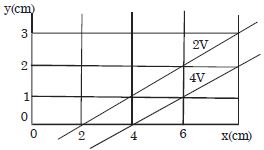
- 3Figure shows two equipotential lines in $x, y$ plane for an electric field. The scales are marked. The $x-$ component $E_x$ and $y$ -component $E_y$ of the electric field in the space between these equipotential lines are respectively :-View Solution
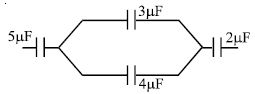
- 4If charge on left plane of the $5\ \mu F$ capacitor in the circuit segment shown in the figure is $-20\ \mu C$, the charge on the right plate of $3\ \mu F$ capacitor is.......$ \mu C$View Solution
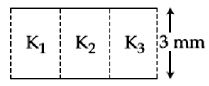
- 5A parallel plate capacitor is of area $6\, cm^2$ and a separation $3\, mm$. The gap is filled with three dielectric materials of equal thickness (see figure) with dielectric constants $K_1 = 10, K_2 = 12$ and $K_3 = 14$. The dielectric constant of a material which when fully inserted in above capacitor, gives same capacitance would beView Solution
- 6View SolutionA long, hollow conducting cylinder is kept coaxially inside another long, hollow conducting cylinder of larger radius. Both the cylinders are initially electrically neutral.
- 7Two plates are $2\,cm$ apart, a potential difference of $10\;volt$ is applied between them, the electric field between the plates is.........$N/C$View Solution
- 8Two point charges $4\,\mu C$ and $ - 1\,\mu C$ are kept at a distance of $3\ m$ from each other. What is the electric potential at the point where the electric field is zero?......$V$View Solution
- 9If $E$ is the electric field intensity of an electrostatic field, then the electrostatic energy density is proportional toView Solution
- 10A hollow metallic sphere of radius $R$ is given a charge $Q$. Then the potential at the centre isView Solution