An electron is moving along the positive $X$-axis. You want to apply a magnetic field for a short time so that the electron may reverse its direction and move parallel to the negative $X$-axis. This can be done by applying the magnetic field along
Easy


Download our appand get started for free
Experience the future of education. Simply download our apps or reach out to us for more information. Let's shape the future of learning together!No signup needed.*
Similar Questions
- 1A uniform magnetic field of $2 \times 10^{-3} \mathrm{~T}$ acts along positive $\mathrm{Y}$-direction. A rectangular loop of sides $20$ $\mathrm{cm}$ and $10 \mathrm{~cm}$ with current of $5 \mathrm{~A}$ is $\mathrm{Y}-\mathrm{Z}$ plane. The current is in anticlockwise sense with reference to negative $\mathrm{X}$ axis. Magnitude and direction of the torque is :View Solution
- 2A galvanometer of resistance $G$ is converted into a voltmeter of range $0-1\, V$ by connecting a resistance $R _{1}$ in series with it. The additional resistance that should be connected in series with $R _{1}$ to increase the range of the voltmeter to $0-2\, V$ will beView Solution
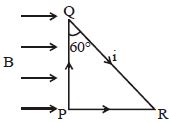
- 3For the circuit shown in figure, the direction and magnitude of the force on $PQR$ is :-View Solution
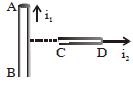
- 4An infinitely long straight conductor $AB$ is fixed and a current is passed through it. Another movable straight wire $CD$ of finite length and carrying current is held perpendicular to it and released. Neglect weight of the wireView Solution
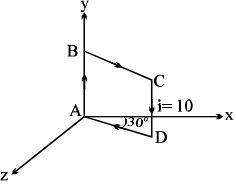
- 5Figure shows a square current carrying loop $ABCD$ of side $10\,\, cm$ and current $i = 10\,A$. The magnetic moment $\vec M$ of the loop isView Solution
- 6A uniform magnetic field $B$ is acting from south to north and is of magnitude $1.5$ $Wb/{m^2}$. If a proton having mass $ = 1.7 \times {10^{ - 27}}\,kg$ and charge $ = 1.6 \times {10^{ - 19}}\,C$ moves in this field vertically downwards with energy $5\, MeV$, then the force acting on it will beView Solution
- 7If $n$ represents the actual number of deflections in a converted galvanometer of resistance $G$ and shunt resistance $S$. Then the total current I when its figure of merit is $K$ will beView Solution
- 8View SolutionThe resistance of an ideal voltmeter is
- 9A steady eletric current is flowing through a cylindrical wireView Solution
$(a)$ the electric field at the axis of wire is zero
$(b)$ the magnetic field at the axis of wire is zero
$(c)$ the electric field in the vicinity of wire is Zero.
$(d)$ the magnetic field in the vicinity of wire is Zero - 10A beam of neutrons performs circular motion of radius, $r=1 \,m$. Under the influence of an inhomogeneous magnetic field with inhomogeneity extending over $\Delta r=0.01 \,m$. The speed of the neutrons is $54 \,m / s$. The mass and magnetic moment of the neutrons respectively are $1.67 \times 10^{-27} \,kg$ and $9.67 \times 10^{-27} \,J / T$. The average variation of the magnetic field over $\Delta r$ is approximately ....... $T$View Solution